Is scientific publishing about to be disrupted?

Part I: How Industries Fail

Until three years ago, the oldest company in the world was the construction company Kongo Gumi, headquartered in Osaka, Japan. Kongo Gumi was founded in 578 CE when the then-regent of Japan, Prince Shotoku, brought a member of the Kongo family from Korea to Japan to help construct the first Buddhist temple in Japan, the Shitenno-ji. The Kongo Gumi continued in the construction trade for almost one and a half thousand years. In 2005, they were headed by Masakazu Kongo, the 40th of his family to head Kongo Gumi. The company had more than 100 employees, and 70 million dollars in revenue. But in 2006, Kongo Gumi went into liquidation, and its assets were purchased by Takamatsu Corporation. Kongo Gumi as an independent entity no longer exists.

How is it that large, powerful organizations, with access to vast sums of money, and many talented, hardworking people, can simply disappear? Examples abound – consider General Motors, Lehman Brothers and MCI Worldcom – but the question is most fascinating when it is not just a single company that goes bankrupt, but rather an entire industry is disrupted. In the 1970s, for example, some of the world’s fastest-growing companies were companies like Digital Equipment Corporation, Data General and Prime. They made minicomputers like the legendary PDP-11. None of these companies exist today. A similar disruption is happening now in many media industries. CD sales peaked in 2000, shortly after Napster started, and have declined almost 30 percent since. Newspaper advertising revenue in the United States has declined 30 percent in the last 3 years, and the decline is accelerating: one third of that fall came in the last quarter.

There are two common explanations for the disruption of industries like minicomputers, music, and newspapers. The first explanation is essentially that the people in charge of the failing industries are stupid. How else could it be, the argument goes, that those enormous companies, with all that money and expertise, failed to see that services like iTunes and Last.fm are the wave of the future? Why did they not pre-empt those services by creating similar products of their own? Polite critics phrase their explanations less bluntly, but nonetheless many explanations boil down to a presumption of stupidity. The second common explanation for the failure of an entire industry is that the people in charge are malevolent. In that explanation, evil record company and newspaper executives have been screwing over their customers for years, simply to preserve a status quo that they personally find comfortable.

It’s true that stupidity and malevolence do sometimes play a role in the disruption of industries. But in the first part of this essay I’ll argue that even smart and good organizations can fail in the face of disruptive change, and that there are common underlying structural reasons why that’s the case. That’s a much scarier story. If you think the newspapers and record companies are stupid or malevolent, then you can reassure yourself that provided you’re smart and good, you don’t have anything to worry about. But if disruption can destroy even the smart and the good, then it can destroy anybody. In the second part of the essay, I’ll argue that scientific publishing is in the early days of a major disruption, with similar underlying causes, and will change radically over the next few years.

Why online news is killing the newspapers

To make our discussion of disruption concrete, let’s think about why many blogs are thriving financially, while the newspapers are dying. This subject has been discussed extensively in many recent articles, but my discussion is different because it focuses on identifying general structural features that don’t just explain the disruption of newspapers, but can also help explain other disruptions, like the collapse of the minicomputer and music industries, and the impending disruption of scientific publishing.

Some people explain the slow death of newspapers by saying that blogs and other online sources [1] are news parasites, feeding off the original reporting done by the newspapers. That’s false. While it’s true that many blogs don’t do original reporting, it’s equally true that many of the top blogs do excellent original reporting. A good example is the popular technology blog TechCrunch, by most measures one of the top 100 blogs in the world. Started by Michael Arrington in 2005, TechCrunch has rapidly grown, and now employs a large staff. Part of the reason it’s grown is because TechCrunch’s reporting is some of the best in the technology industry, comparable to, say, the technology reporting in the New York Times. Yet whereas the New York Times is wilting financially [2], TechCrunch is thriving, because TechCrunch’s operating costs are far lower, per word, than the New York Times. The result is that not only is the audience for technology news moving away from the technology section of newspapers and toward blogs like TechCrunch, the blogs can undercut the newspaper’s advertising rates. This depresses the price of advertising and causes the advertisers to move away from the newspapers.

Unfortunately for the newspapers, there’s little they can do to make themselves cheaper to run. To see why that is, let’s zoom in on just one aspect of newspapers: photography. If you’ve ever been interviewed for a story in the newspaper, chances are a photographer accompanied the reporter. You get interviewed, the photographer takes some snaps, and the photo may or may not show up in the paper. Between the money paid to the photographer and all the other costs, that photo probably costs the newspaper on the order of a few hundred dollars [3]. When TechCrunch or a similar blog needs a photo for a post, they’ll use a stock photo, or ask their subject to send them a snap, or whatever. The average cost is probably tens of dollars. Voila! An order of magnitude or more decrease in costs for the photo.

Here’s the kicker. TechCrunch isn’t being any smarter than the newspapers. It’s not as though no-one at the newspapers ever thought “Hey, why don’t we ask interviewees to send us a polaroid, and save some money?” Newspapers employ photographers for an excellent business reason: good quality photography is a distinguishing feature that can help establish a superior newspaper brand. For a high-end paper, it’s probably historically been worth millions of dollars to get stunning, Pulitzer Prizewinning photography. It makes complete business sense to spend a few hundred dollars per photo.

What can you do, as a newspaper editor? You could fire your staff photographers. But if you do that, you’ll destroy the morale not just of the photographers, but of all your staff. You’ll stir up the Unions. You’ll give a competitive advantage to your newspaper competitors. And, at the end of the day, you’ll still be paying far more per word for news than TechCrunch, and the quality of your product will be no more competitive.

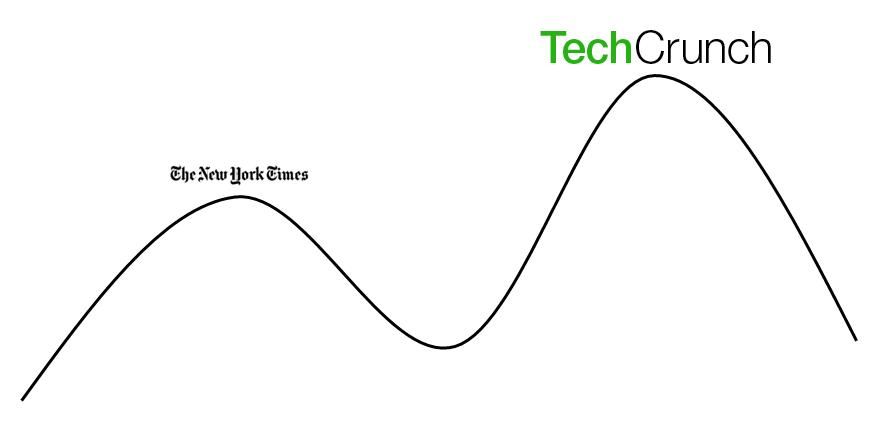
The problem is that your newspaper has an organizational architecture which is, to use the physicists’ phrase, a local optimum. Relatively small changes to that architecture – like firing your photographers – don’t make your situation better, they make it worse. So you’re stuck gazing over at TechCrunch, who is at an even better local optimum, a local optimum that could not have existed twenty years ago:

local_optimum.jpg

Unfortunately for you, there’s no way you can get to that new optimum without attempting passage through a deep and unfriendly valley. The incremental actions needed to get there would be hell on the newspaper. There’s a good chance they’d lead the Board to fire you.

The result is that the newspapers are locked into producing a product that’s of comparable quality (from an advertiser’s point of view) to the top blogs, but at far greater cost. And yet all their decisions – like the decision to spend a lot on photography – are entirely sensible business decisions. Even if they’re smart and good, they’re caught on the horns of a cruel dilemma.

The same basic story can be told about the dispruption of the music industry, the minicomputer industry, and many other disruptions. Each industry has (or had) a standard organizational architecture. That organizational architecture is close to optimal, in the sense that small changes mostly make things worse, not better. Everyone in the industry uses some close variant of that architecture. Then a new technology emerges and creates the possibility for a radically different organizational architecture, using an entirely different combination of skills and relationships. The only way to get from one organizational architecture to the other is to make drastic, painful changes. The money and power that come from commitment to an existing organizational architecture actually place incumbents at a disadvantage, locking them in. It’s easier and more effective to start over, from scratch.

Organizational immune systems

I’ve described why it’s hard for incumbent organizations in a disrupted industry to change to a new model. The situation is even worse than I’ve described so far, though, because some of the forces preventing change are strongest in the best run organizations. The reason is that those organizations are large, complex structures, and to survive and prosper they must contain a sort of organizational immune system dedicated to preserving that structure. If they didn’t have such an immune system, they’d fall apart in the ordinary course of events. Most of the time the immune system is a good thing, a way of preserving what’s good about an organization, and at the same time allowing healthy gradual change. But when an organization needs catastrophic gut-wrenching change to stay alive, the immune system becomes a liability.

To see how such an immune system expresses itself, imagine someone at the New York Times had tried to start a service like Google News, prior to Google News. Even before the product launched they would have been constantly attacked from within the organization for promoting competitors’ products. They would likely have been forced to water down and distort the service, probably to the point where it was nearly useless for potential customers. And even if they’d managed to win the internal fight and launched a product that wasn’t watered down, they would then have been attacked viciously by the New York Times’ competitors, who would suspect a ploy to steal business. Only someone outside the industry could have launched a service like Google News.

Another example of the immune response is all the recent news pieces lamenting the death of newspapers. Here’s one such piece, from the Editor of the New York Times’ editorial page, Andrew Rosenthal:

There’s a great deal of good commentary out there on the Web, as you say. Frankly, I think it is the task of bloggers to catch up to us, not the other way around… Our board is staffed with people with a wide and deep range of knowledge on many subjects. Phil Boffey, for example, has decades of science and medical writing under his belt and often writes on those issues for us… Here’s one way to look at it: If the Times editorial board were a single person, he or she would have six Pulitzer prizes…

This is a classic immune response. It demonstrates a deep commitment to high-quality journalism, and the other values that have made the New York Times great. In ordinary times this kind of commitment to values would be a sign of strength. The problem is that as good as Phil Boffey might be, I prefer the combined talents of Fields medallist Terry Tao, Nobel prize winner Carl Wieman, MacArthur Fellow Luis von Ahn, acclaimed science writer Carl Zimmer, and thousands of others. The blogosophere has at least four Fields medallists (the Nobel of math), three Nobelists, and many more luminaries. The New York Times can keep its Pulitzer Prizes. Other lamentations about the death of newspapers show similar signs of being an immune response. These people aren’t stupid or malevolent. They’re the best people in the business, people who are smart, good at their jobs, and well-intentioned. They are, in short, the people who have most strongly internalized the values, norms and collective knowledge of their industry, and thus have the strongest immune response. That’s why the last people to know an industry is dead are the people in it. I wonder if Andrew Rosenthal and his colleagues understand that someone equipped with an RSS reader can assemble a set of news feeds that renders the New York Times virtually irrelevant? If a person inside an industry needs to frequently explain why it’s not dead, they’re almost certainly wrong.

What are the signs of impending disruption?

Five years ago, most newspaper editors would have laughed at the idea that blogs might one day offer serious competition. The minicomputer companies laughed at the early personal computers. New technologies often don’t look very good in their early stages, and that means a straightup comparison of new to old is little help in recognizing impending dispruption. That’s a problem, though, because the best time to recognize disruption is in its early stages. The journalists and newspaper editors who’ve only recognized their problems in the last three to four years are sunk. They needed to recognize the impending disruption back before blogs looked like serious competitors, when evaluated in conventional terms.

An early sign of impending disruption is when there’s a sudden flourishing of startup organizations serving an overlapping customer need (say, news), but whose organizational architecture is radically different to the conventional approach. That means many people outside the old industry (and thus not suffering from the blinders of an immune response) are willing to bet large sums of their own money on a new way of doing things. That’s exactly what we saw in the period 2000-2005, with organizations like Slashdot, Digg, Fark, Reddit, Talking Points Memo, and many others. Most such startups die. That’s okay: it’s how the new industry learns what organizational architectures work, and what don’t. But if even a few of the startups do okay, then the old players are in trouble, because the startups have far more room for improvement.

Part II: Is scientific publishing about to be disrupted?

What’s all this got to do with scientific publishing? Today, scientific publishers are production companies, specializing in services like editorial, copyediting, and, in some cases, sales and marketing. My claim is that in ten to twenty years, scientific publishers will be technology companies [4]. By this, I don’t just mean that they’ll be heavy users of technology, or employ a large IT staff. I mean they’ll be technology-driven companies in a similar way to, say, Google or Apple. That is, their foundation will be technological innovation, and most key decision-makers will be people with deep technological expertise. Those publishers that don’t become technology driven will die off.

Predictions that scientific publishing is about to be disrupted are not new. In the late 1990s, many people speculated that the publishers might be in trouble, as free online preprint servers became increasingly popular in parts of science like physics. Surely, the argument went, the widespread use of preprints meant that the need for journals would diminish. But so far, that hasn’t happened. Why it hasn’t happened is a fascinating story, which I’ve discussed in part elsewhere, and I won’t repeat that discussion here.

What I will do instead is draw your attention to a striking difference between today’s scientific publishing landscape, and the landscape of ten years ago. What’s new today is the flourishing of an ecosystem of startups that are experimenting with new ways of communicating research, some radically different to conventional journals. Consider Chemspider, the excellent online database of more than 20 million molecules, recently acquired by the Royal Society of Chemistry. Consider Mendeley, a platform for managing, filtering and searching scientific papers, with backing from some of the people involved in Last.fm and Skype. Or consider startups like SciVee (YouTube for scientists), the Public Library of Science, the Journal of Visualized Experiments, vibrant community sites like OpenWetWare and the Alzheimer Research Forum, and dozens more. And then there are companies like WordPress, Friendfeed, and Wikimedia, that weren’t started with science in mind, but which are increasingly helping scientists communicate their research. This flourishing ecosystem is not too dissimilar from the sudden flourishing of online news services we saw over the period 2000 to 2005.

Let’s look up close at one element of this flourishing ecosystem: the gradual rise of science blogs as a serious medium for research. It’s easy to miss the impact of blogs on research, because most science blogs focus on outreach. But more and more blogs contain high quality research content. Look at Terry Tao’s wonderful series of posts explaining one of the biggest breakthroughs in recent mathematical history, the proof of the Poincare conjecture. Or Tim Gowers recent experiment in “massively collaborative mathematics”, using open source principles to successfully attack a significant mathematical problem. Or Richard Lipton’s excellent series of posts exploring his ideas for solving a major problem in computer science, namely, finding a fast algorithm for factoring large numbers. Scientific publishers should be terrified that some of the world’s best scientists, people at or near their research peak, people whose time is at a premium, are spending hundreds of hours each year creating original research content for their blogs, content that in many cases would be difficult or impossible to publish in a conventional journal. What we’re seeing here is a spectacular expansion in the range of the blog medium. By comparison, the journals are standing still.

This flourishing ecosystem of startups is just one sign that scientific publishing is moving from being a production industry to a technology industry. A second sign of this move is that the nature of information is changing. Until the late 20th century, information was a static entity. The natural way for publishers in all media to add value was through production and distribution, and so they employed people skilled in those tasks, and in supporting tasks like sales and marketing. But the cost of distributing information has now dropped almost to zero, and production and content costs have also dropped radically [5]. At the same time, the world’s information is now rapidly being put into a single, active network, where it can wake up and come alive. The result is that the people who add the most value to information are no longer the people who do production and distribution. Instead, it’s the technology people, the programmers.

If you doubt this, look at where the profits are migrating in other media industries. In music, they’re migrating to organizations like Apple. In books, they’re migrating to organizations like Amazon, with the Kindle. In many other areas of media, they’re migrating to Google: Google is becoming the world’s largest media company. They don’t describe themselves that way (see also here), but the media industry’s profits are certainly moving to Google. All these organizations are run by people with deep technical expertise. How many scientific publishers are run by people who know the difference between an INNER JOIN and an OUTER JOIN? Or who know what an A/B test is? Or who know how to set up a Hadoop cluster? Without technical knowledge of this type it’s impossible to run a technology-driven organization. How many scientific publishers are as knowledgeable about technology as Steve Jobs, Sergey Brin, or Larry Page?

I expect few scientific publishers will believe and act on predictions of disruption. One common response to such predictions is the appealing game of comparison: “but we’re better than blogs / wikis / PLoS One / …!” These statements are currently true, at least when judged according to the conventional values of scientific publishing. But they’re as irrelevant as the equally true analogous statements were for newspapers. It’s also easy to vent standard immune responses: “but what about peer review”, “what about quality control”, “how will scientists know what to read”. These questions express important values, but to get hung up on them suggests a lack of imagination much like Andrew Rosenthal’s defense of the New York Times editorial page. (I sometimes wonder how many journal editors still use Yahoo!’s human curated topic directory instead of Google?) In conversations with editors I repeatedly encounter the same pattern: “But idea X won’t work / shouldn’t be allowed / is bad because of Y.” Well, okay. So what? If you’re right, you’ll be intellectually vindicated, and can take a bow. If you’re wrong, your company may not exist in ten years. Whether you’re right or not is not the point. When new technologies are being developed, the organizations that win are those that aggressively take risks, put visionary technologists in key decision-making positions, attain a deep organizational mastery of the relevant technologies, and, in most cases, make a lot of mistakes. Being wrong is a feature, not a bug, if it helps you evolve a model that works: you start out with an idea that’s just plain wrong, but that contains the seed of a better idea. You improve it, and you’re only somewhat wrong. You improve it again, and you end up the only game in town. Unfortunately, few scientific publishers are attempting to become technology-driven in this way. The only major examples I know of are Nature Publishing Group (with Nature.com) and the Public Library of Science. Many other publishers are experimenting with technology, but those experiments remain under the control of people whose core expertise is in others areas.

Opportunities

So far this essay has focused on the existing scientific publishers, and it’s been rather pessimistic. But of course that pessimism is just a tiny part of an exciting story about the opportunities we have to develop new ways of structuring and communicating scientific information. These opportunities can still be grasped by scientific publishers who are willing to let go and become technology-driven, even when that threatens to extinguish their old way of doing things. And, as we’ve seen, these opportunites are and will be grasped by bold entrepreneurs. Here’s a list of services I expect to see developed over the next few years. A few of these ideas are already under development, mostly by startups, but have yet to reach the quality level needed to become ubiquitous. The list could easily be continued ad nauseum – these are just a few of the more obvious things to do.

Personalized paper recommendations: Amazon.com has had this for books since the late 1990s. You go to the site and rate your favourite books. The system identifies people with similar taste, and automatically constructs a list of recommendations for you. This is not difficult to do: Amazon has published an early variant of its algorithm, and there’s an entire ecosystem of work, much of it public, stimulated by the Neflix Prize for movie recommendations. If you look in the original Google PageRank paper, you’ll discover that the paper describes a personalized version of PageRank, which can be used to build a personalized search and recommendation system. Google doesn’t actually use the personalized algorithm, because it’s far more computationally intensive than ordinary PageRank, and even for Google it’s hard to scale to tens of billions of webpages. But if all you’re trying to rank is (say) the physics literature – a few million papers – then it turns out that with a little ingenuity you can implement personalized PageRank on a small cluster of computers. It’s possible this can be used to build a system even better than Amazon or Netflix.

A great search engine for science: ISI’s Web of Knowledge, Elsevier’s Scopus and Google Scholar are remarkable tools, but there’s still huge scope to extend and improve scientific search engines [6]. With a few exceptions, they don’t do even basic things like automatic spelling correction, good relevancy ranking of papers (preferably personalized), automated translation, or decent alerting services. They certainly don’t do more advanced things, like providing social features, or strong automated tools for data mining. Why not have a public API [7] so people can build their own applications to extract value out of the scientific literature? Imagine using techniques from machine learning to automatically identify underappreciated papers, or to identify emerging areas of study.

High-quality tools for real-time collaboration by scientists: Look at services like the collaborative editor Etherpad, which lets multiple people edit a document, in real time, through the browser. They’re even developing a feature allowing you to play back the editing process. Or the similar service from Google, Google Docs, which also offers shared spreadsheets and presentations. Look at social version control systems like Git and Github. Or visualization tools which let you track different people’s contributions. These are just a few of hundreds of general purpose collaborative tools that are lightyears beyond what scientists use. They’re not widely adopted by scientists yet, in part for superficial reasons: they don’t integrate with things like LaTeX and standard bibliographical tools. Yet achieving that kind of integration is trivial compared with the problems these tools do solve. Looking beyond, services like Google Wave may be a platform for startups to build a suite of collaboration clients that every scientist in the world will eventually use.

Scientific blogging and wiki platforms: With the exception of Nature Publishing Group, why aren’t the scientific publishers developing high-quality scientific blogging and wiki platforms? It would be easy to build upon the open source WordPress platform, for example, setting up a hosting service that makes it easy for scientists to set up a blog, and adds important features not present in a standard WordPress installation, like reliable signing of posts, timestamping, human-readable URLs, and support for multiple post versions, with the ability to see (and cite) a full revision history. A commenter-identity system could be created that enabled filtering and aggregation of comments. Perhaps most importantly, blog posts could be made fully citable.

On a related note, publishers could also help preserve some of the important work now being done on scientific blogs and wikis. Projects like Tim Gowers’ Polymath Project are an important part of the scientific record, but where is the record of work going to be stored in 10 or 20 years time? The US Library of Congress has taken the initiative in preserving law blogs. Someone needs to step up and do the same for science blogs.

The data web: Where are the services making it as simple and easy for scientists to publish data as it to publish a journal paper or start a blog? A few scientific publishers are taking steps in this direction. But it’s not enough to just dump data on the web. It needs to be organized and searchable, so people can find and use it. The data needs to be linked, as the utility of data sets grows in proportion to the connections between them. It needs to be citable. And there needs to be simple, easy-to-use infrastructure and expertise to extract value from that data. On every single one of these issues, publishers are at risk of being leapfrogged by companies like Metaweb, who are building platforms for the data web.

Why many services will fail: Many unsuccessful attempts at implementing services like those I’ve just described have been made. I’ve had journal editors explain to me that this shows there is no need for such services. I think in many cases there’s a much simpler explanation: poor execution [8]. Development projects are often led by senior editors or senior scientists whose hands-on technical knowledge is minimal, and whose day-to-day involvement is sporadic. Implementation is instead delegated to IT-underlings with little power. It should surprise no one that the results are often mediocre. Developing high-quality web services requires deep knowledge and drive. The people who succeed at doing it are usually brilliant and deeply technically knowledgeable. Yet it’s surprisingly common to find projects being led by senior scientists or senior editors whose main claim to “expertise” is that they wrote a few programs while a grad student or postdoc, and who now think they can get a high-quality result with minimal extra technical knowledge. That’s not what it means to be technology-driven.

Conclusion: I’ve presented a pessimistic view of the future of current scientific publishers. Yet I hope it’s also clear that there are enormous opportunities to innovate, for those willing to master new technologies, and to experiment boldly with new ways of doing things. The result will be a great wave of innovation that changes not just how scientific discoveries are communicated, but also accelerates the way scientific discoveries are made.

Notes

[1] We’ll focus on blogs to make the discussion concrete, but in fact many new forms of media are contributing to the newspapers’ decline, including news sites like Digg and MetaFilter, analysis sites like Stratfor, and many others. When I write “blogs” in what follows I’m usually referring to this larger class of disruptive new media, not literally to conventional blogs, per se.

[2] In a way, it’s ironic that I use the New York Times as an example. Although the New York Times is certainly going to have a lot of trouble over the next five years, in the long run I think they are one of the newspapers most likely to survive: they produce high-quality original content, show strong signs of becoming technology driven, and are experimenting boldly with alternate sources of content. But they need to survive the great newspaper die-off that’s coming over the next five or so years.

[3] In an earlier version of this essay I used the figure 1,000 dollars. That was sloppy – it’s certainly too high. The actual figure will certainly vary quite a lot from paper to paper, but for a major newspaper in a big city I think on the order of 200-300 dollars is a reasonable estimate, when all costs are factored in.

[4] I’ll use the term “companies” to include for-profit and not-for-profit organizations, as well as other organizational forms. Note that the physics preprint arXiv is arguably the most successful publisher in physics, yet is neither a conventional for-profit or not-for-profit organization.

[5] This drop in production and distribution costs is directly related to the current move toward open access publication of scientific papers. This movement is one of the first visible symptoms of the disruption of scientific publishing. Much more can and has been said about the impact of open access on publishing; rather than review that material, I refer you to the blog “Open Access News”, and in particular to Peter Suber’s overview of open access.

[6] In the first version of this essay I wrote that the existing services were “mediocre”. That’s wrong, and unfair: they’re very useful services. But there’s a lot of scope for improvement.

[7] After posting this essay, Christina Pikas pointed out that Web of Science and Scopus do have APIs. That’s my mistake, and something I didn’t know.

[8] There are also services where the primary problem is cultural barriers. But for the ideas I’ve described cultural barriers are only a small part of the problem.

Acknowledgments: Thanks to Jen Dodd and Ilya Grigorik for many enlightening discussions.

About this essay: This essay is based on a colloquium given June 11, 2009, at the American Physical Society Editorial Offices. Many thanks to the people at the APS for being great hosts, and for many stimulating conversations.

Further reading: I’m writing a book about “The Future of Science”. A summary of many of the themes in the book is available in this essay. If you’d like to be notified when the book is available, please send a blank email to the.future.of.science@gmail.com with the subject “subscribe book”. I’ll email you to let you know in advance of publication. I will not use your email address for any other purpose! You can subscribe to my blog here.

My account of how industries fail was influenced by and complements Clayton Christensen’s book “The Innovator’s Dilemma”. Three of my favourite blogs about the future of scientific communication are “Science in the Open”, “Open Access News” and “Common Knowledge”. Of course, there are many more excellent sources of information on this topic. A good source aggregating these many sources is the Science 2.0 room on FriendFeed.

177 Comments »

  1. Daniel Lemire said,

    June 29, 2009 @ 3:13 pm

    Brilliant. Insightful.

    Sorry, I just had to say it.

    ;-)

  2. Tom said,

    June 29, 2009 @ 4:36 pm

    Yup, well-written. Archiving science blogs would be especially nice!

    Note also that blogs have sometimes backreation into the traditionnal publishing world, for instance Terence Tao turns each year of his blog into an AMS book, and there are probably many more examples.

    As for peer-review, I’m dreaming of a way to make all the interactions between authors, reviewers and paper citations visible (some kind of customizable graph). This would allow to easily localize solid new trends, as well as low-quality researchers (the ones which self-cite a lot without innovation and get reviewed by friends just to add a line in their publication list).

  3. Andrew Maynard said,

    June 29, 2009 @ 5:13 pm

    Exceptionally insightful essay. You present the challenges faced by scientific publishing persuasively.

    What is going to be interesting is seeing whether the scientific community can adapt and develop strategies to embrace the opportunities you outline. Perhaps one of the greatest dangers of limited proactive action is effective peer to peer science communication and archiving falling between the gaps – the current local optimum being undermined before a new one – that serves the community equally well or better – is established.

    (I’m cynically assuming of course that social/market forces could lead to a new paradigm that kills off mainstream publishing without leading to an equivalent or superior alternative)

  4. L’activité scientifique à l’heure d’internet « Nanostelia said,

    June 29, 2009 @ 5:52 pm

    [...] Michael Nielsen, est ce que les publications scientifiques vont disparaître ? (en [...]

  5. Sarah said,

    June 29, 2009 @ 6:18 pm

    Nice essay – and lots of links & references I’d like to check out.

    I agree that the potential of the web for improving communication/collaboration is huge and largely untapped. I work on several large international projects and it’s frustrating how unwilling people are to use new technologies – even as simple as obviously useful as a wiki. I guess for the generation of scientists that are currently “in charge” blogs, wikis, social networking platforms, are considered new and … frivolous?

  6. Cmaury said,

    June 29, 2009 @ 7:00 pm

    Absolutely Right. Well deserved of the Techcrunch RT and post.

    I dont think it will take 10 years to supplant academic journals though. All that is missing, is a means to replicate the reputation building and content filtering for “quality” that journals currently do better than online, open-source means. Blogs have already done this to print media; how long will it take to do the same to journals?

  7. Asciidan said,

    June 29, 2009 @ 7:30 pm

    There is no metric by which a single photograph in a newspaper would cost a thousand dollars. Most photogs will shoot hundreds of frames per week and are paid salaries to do so. Let’s say, for the sake of argument, that a photog is paid $60g per year. In order for the paper to spend a grand per photo, that photog would be shooting less than twice a week. As a newsroom manager, I assure you it doesn’t work that way. At least not in 99.5% of all papers.

  8. Disruption and change in publishing :: in propria persona said,

    June 29, 2009 @ 7:31 pm

    [...] via Michael Nielsen » Is scientific publishing about to be disrupted? [...]

  9. Daniel Lemire said,

    June 29, 2009 @ 7:39 pm

    @Cmaury

    Don’t underestimate the inertia. Some fields are moving quickly, but most of my colleagues in the social sciences do not even know yet that they can download research papers electronically. They are still vastly reliant on a paper-based culture.

    We have come a long, long way in the last ten years. It is now “accepted” to blog as a professor, but it is hardly common. I work for a large university with over 1,000 professors. It is a bona fide research university too. How many professors have serious and long-standing blogs? Stevan Harnad has one (http://openaccess.eprints.org/). Seb Paquet also (http://openresearch.sebpaquet.net/). Short of that… I can’t think of anyone. As a blogger, I still get the usual “I don’t have time to blog” (meaning: it is a frivolous activity) from older professors. Thankfully, people no longer mock me, but if I were to state that blogging counts as “academic publishing” they would mock me.

    There are good and bad reasons why academia moves slowly, but it is undeniable that it does. It has a very, very strong immune system.

  10. Jan said,

    June 29, 2009 @ 7:51 pm

    A great post!

    Another thought I would like to share is that I see there being a potential difference between two attitudes of big companies and why they can be overthrown by a market disruption:

    On the one hand, some companies might be purely “ignoring” new ideas, similar to what Andrew Rosenthal’s comment further above might suggest, or similar to having the opinion “but we are better than X”. These companies might fail because they just ignore innovative ideas or start-ups. The problem with this setup is that in the end there can only be one winner: either it’s the start-up, or the incumbent firm.

    On the other hand, I believe there are also big companies which actually don’t ignore market changes, but which just have not found a way to evolve quickly enough in order to keep up with a changing market. These companies are looking for innovative solutions, but could still fail because they are not able to change with market conditions due to the reasons you mentioned above, or because they haven’t found a strong partner in a quickly evolving environment. Since they are willing to discuss and change, however, such a competitive setup can actually create a win-win situation for both the start-up and the incumbent firm.

    Luckily, at Mendeley, so far we’ve mostly encountered companies of the second type (probably because the companies of the first type just ignore us…)., and I feel that start-ups could also help big companies to find ways of how to create a business model in a changing competitive environment, and therefore create a win-win situation. It’s not that we would bet on this, but it shows additional potential of what can be done.

  11. Nancy Davison said,

    June 29, 2009 @ 7:59 pm

    I found your article to be of immense interest. I do believe all industries must have a look at their senior staff and heavy weight them with technical backgrounds in some manner. Those who move quickest to do so will lead market share in their respective industry.

    The world markets are competitive to those who are forward thinking, reach mass markets in a timely manner, control costs, and can reinvent themselves.

    Those who do will thrive. Technology and the ability to understand the business and social implications of the web is a job in and of itself. Make sure you have a technical researcher on your staff.

    Scientific Papers are the issue of this today but technology is all encompassing, no one, nor will any industry remain untouched from it’s inclusion on everyday life.

  12. Christina Pikas said,

    June 29, 2009 @ 8:09 pm

    Great post – just a few comments:
    wrt disruptive industries – this was hot when I was getting my masters. Evans and Wuster, Blown to Bits, gave a bunch of examples. Britannica was one – beat out by much poorer quality Encarta because they failed to pay attention. I think Thomas Stewart had a few examples,too, but I lost some respect for his work when he gave Enron as a *positive* (in ~1998?)

    wrt newspapers and photographers – they also have a secondary business in storing and reusing images later and they have to have the rights for that – they also sometimes re-license or sell images so that’s another reason they need to fully own the picture, when the blogs don’t

    Maybe a little Weber bureaucracy here – and organizational psychology….

    And there were news aggregators – lots of them – before Google. DIALOG, Factiva (oh, what was it called before that?), Nexis… the difference is that Google is an advertising company, and these others are subscription or services companies.

    wrt publishers becoming technology companies – some/many/most? publishers outsource the technological parts of putting journals up.. oops! What about societies like *cough* ACS who use publication revenue to pay for society activities and then practice immune responses to try to disable competitors?

    Elsevier (I know, I know) is doing a lot of innovating with technology, too. And, as you say, RSC but they’re a society.

    Both WoS and Scopus have APIs that our programmer has used to provide “related article”, and citation links in our openurl resolver. actually. I use RSS and e-mail alerts from them, too. I’ll give you scholar, though :) Oh, and both are actually providing some mining tools – particularly to try to map science, find related papers, and find sleeping beauties.

    couldn’t agree more about preserving science blogs – that is one positive for journals, they do have that figured out.

  13. Scientific Publishers -- trouble on the horizon :: 108Warren Commission said,

    June 29, 2009 @ 8:25 pm

    [...]Michael Nielsen in his blog posted an excellent piece on the nature of disruptive technologies and their impact[...]

  14. Michael Nielsen » Is scientific publishing about to be disrupted? « Netcrema - creme de la social news via digg + delicious + stumpleupon + reddit said,

    June 29, 2009 @ 8:40 pm

    [...] Michael Nielsen » Is scientific publishing about to be disrupted?michaelnielsen.org [...]

  15. ChemSpiderman said,

    June 29, 2009 @ 8:57 pm

    Michael..a well written and thoughtful post about the challenges ahead for the scientific publishing industry.

    Regarding “Scientific blogging and wiki platforms”: for Chemistry specifically I am passionate about making the internet searchable by “Chemistry”..specifically structures and reactions. It’s possible.

    I highlight the last section “Why many services will fail:” and believe that the skills we have taken to the RSC, if we get to focus them appropriately, will show that such issues will not always win over the possibilities that exist.

    We share a lot of common views and I am glad that you took the time to put together this post in such a succinct and focused manner. Sign me up for the book (I’ll send the email..)

  16. Geoff Wozniak said,

    June 29, 2009 @ 9:18 pm

    I highly recommend Beinhocker’s The Origin of Wealth for an in-depth discussion on why existing (and prospering) organizations have trouble adapting to new technologies.

    http://www.amazon.com/Origin-Wealth-Evolution-Complexity-Economics/dp/157851777X

  17. Andrew Spong said,

    June 30, 2009 @ 1:18 am

    Thank you for this, Michael: a compelling analysis, forcefully presented, and a way forward for those within STM publishing who have ears to hear, and the organizational discipline to overcome their ‘immune systems’, as you put it.

    I’ll confess to having laughed out loud at some elements, so perfectly do they map on to my experiences within STM publishing over the past couple of years.

  18. Disruption of The Newspaper Industry | The Daily Dogcast said,

    June 30, 2009 @ 4:02 am

    [...] This timely essay from Michael Nielson is the best explanation yet of what’s happening in the newspaper industry. A long read, but an excellent article, and very timely in relation to DogCast6. [...]

  19. Wybo Wiersma said,

    June 30, 2009 @ 4:57 am

    Really interesting post! :)

    Am really looking forward to the time things start to change in publishing.

    Currently I am working on LogiLogi.org, a project trying to create an informal form of publishing between journals and good conversations (http://en.logilogi.org).

    And in september I am going to do the Digital Humanities MA at Kings College London, to be able to continue working on this and similar projects…

  20. » The Future of … at Chris Klein said,

    June 30, 2009 @ 5:22 am

    [...] brilliant post “Is scientific publishing about to be disrupted?” in Michael Nielsen’s blog. Although it’s about scientific publishing, it gives very [...]

  21. Joerg Heber said,

    June 30, 2009 @ 5:36 am

    This is a wonderful blog post, and I am sure the APS editors found your talk very stimulating!

    There seems a slight difference between newspapers and science publishing though. In science publishing it still matters (to some and to some degree) where something is published. Google News is successful because it mostly doesn’t matter from which newspapers it pulls the news together.

    At the moment, publication of a scientific paper carries an implicit (albeit not always accurate) notion of trust and relative value depending on place of publication. As you mention, this may eventually be replaced by some sort of page rank algorithm or a voting system – albeit these approaches only work with a certain delay. But what would be interesting might be a more instant expression of potential quality, similar to what we have now with the journal system.

    Last but not least, what is discussed so far is a change in publication medium and technology, and not the system of publishing papers (why publishing science in these little pieces at all?), and in the peer review process. Things like open notebook science might be truly disruptive in this area….

  22. My daily readings 06/30/2009 « Strange Kite said,

    June 30, 2009 @ 7:40 am

    [...] Michael Nielsen » Is scientific publishing about to be disrupted? [...]

  23. Frank Daley said,

    June 30, 2009 @ 7:56 am

    Another example is of course Microsoft.

    Internally it faces battles analogous to those of the newspaper industry.

    The funny thing is that Microsoft’s recent competitive posturing involves even closer ties with the newspaper and big media – industries facing their own massive downward spirals.

    Just amazing that people (and organizations) still hold on to their shares of Microsoft when the writing on the wall is so clear.

  24. Daniel Mietchen said,

    June 30, 2009 @ 10:00 am

    Dear Michael,

    thank you very much for sharing this important set of insights. I am looking forward to similar posts on other aspects of the scientific research cycle, and to the integration of all this into some more permanent and more collaborative medium than this blog.

  25. Michael Nielsen said,

    June 30, 2009 @ 10:05 am

    Andrew Maynard – I certainly think that’s a possibility. To some extent, that seems to be what’s going on with the newspapers: they’re dying, but it’s not yet entirely clear how (or if) their services will be replaced.

  26. Michael Nielsen said,

    June 30, 2009 @ 10:12 am

    Sarah – Yes, it can certainly be tough to convince senior people to be involved! In part with good reason: some of these tools aren’t ready for prime time, and I guess they’re understandably reluctant to be early adopters / beta testers. With that said, I think that showing successful existing uses can really help convince people to take the plunge. I tried to do that in a talk I gave earlier this year (http://michaelnielsen.org/blog/?p=545 ).

  27. rianjs.net » A little morning reading said,

    June 30, 2009 @ 10:16 am

    [...] read an article last night by Michael Nielsen entitled "Is scientific publishing about to be disrupted?" It was probably one of the best articles I've read in at least a month. This morning I [...]

  28. Michael Nielsen said,

    June 30, 2009 @ 10:19 am

    Asciidan: Do you mean that the photographer is shooting hundreds of shots that end up in the paper each week? Or just hundreds of shots? That latter wouldn’t surprise me, but the former certainly would: every time I’ve seen a photographer at work, it’s usually taken them a couple of hours work (including travel, setup etc) to get one photo that’s actually used in the paper. And sometimes nothing at all gets into the paper. Of course, in those shoots they’ll often take dozens of photos, but most are discarded.

    My cost estimate was based not just on the photographer’s salary, but also on all the associated costs: captioning, the sub-editors, overhead, etc. You may well be right that the estimate is high (it was just a back-of-the-envelope calculation), but I think it’s very likely that TechCrunch is spending at least an order of magnitude less per photo than the papers.

  29. Tony Wasserman said,

    June 30, 2009 @ 10:22 am

    I was General Chairman of the recent 5th International Conference on Open Source Systems, sponsored by IFIP. By pre-existing agreement, IFIP conference proceedings are commercially published in closed format (book and PDF articles) by Springer Verlag. We are actively exploring the possibility of finding alternatives for future conferences. We are also planning to publish selected papers with an open access agreement in JAIS (Journal of the Association for Information Systems, having rejected the International Journal on Open Source Systems, a closed journal commercially published by IGI-Global.

    Readers of this blog may also be aware that Bloomsbury Academic has announced its intent to publish using a Creative Commons license. Also, scribd (www.scribd.com) offers low-cost commercial versions of works from MIT Press and others.

    Academic promotion remains a barrier to widespread disruption of traditional publication of scientific works. In each field, there are established journals and conferences which are highly regarded by senior faculty who make the tenure decisions for junior faculty. Junior faculty must make every effort to publish their research in these peer-reviewed journals and conferences, or risk their promotion. The online journal First Monday has high quality content, but still lacks the academic cred needed to attract junior faculty as contributors.

  30. Michael Nielsen said,

    June 30, 2009 @ 10:41 am

    Jan – Thanks for the comment. A related point is that sometimes the old companies eventually respond by buying up the new companies. This can work, but is risky: often the acquired company goes downhill. For example, my impression is that MySpace has lost a lot of momentum under Murdoch. Sometimes the old companies wait too long to act, and they instead end up being acquired by the new companies, or simply fade. Of course, even if an acquisition happens and is successful, it’s debatable to what extent the company remains the same company. I doubt the apparent success of the New York Times’ blogging endeavours gives much solace to its beat reporters.

  31. Kathy Kolbe said,

    June 30, 2009 @ 10:56 am

    This analysis of the naturally destructive/constructive forces that are influencing the future scientific publishing offers hope because:
    1. It exemplifies the high quality writing/thinking that should be disseminated
    2. It offers hope that the closed-door society of scientific publishing will be opened.
    3. It explains a process that could also be our best hope of disupting the seemingly entrenched public school system.
    4. It provides evidence of its own prognastication: I found it on Twitter.

  32. crashsystems's status on Tuesday, 30-Jun-09 16:29:03 UTC - Identi.ca said,

    June 30, 2009 @ 12:29 pm

    [...] http://michaelnielsen.org/blog/?p=629 [...]

  33. David Crotty said,

    June 30, 2009 @ 12:34 pm

    Excellent article Michael, definitely food for thought. A few random comments:

    Is TechCrunch really the best example? Their reputation appears to be dropping lower and lower along with their credibility. Examples here and here.

    One question I have is whether the newspapers are directly competing with the blogs as much as you think. Certainly there are aspects of newspapers that are going head to head with blogs, gossip columns (and things like TechCrunch would qualify here), coverage of niche areas (TechCrunch fits here as well), editorials, science sections, etc. But what about straightforward general news reporting? Aren’t most “news” blogs just link blogs to actual newspapers? I’d argue that for newspapers, the biggest issue has been a lowering of quality to a point where they’re all nearly identical. Since they’re all available for free online with little differentiation (they’re all the same wire feeds), this has led to a saturation of the market, resulting in lower ad rates (along with a loss of classified income to Craigslist). Since ads won’t support an online newspaper, the obvious option is to require a subscription, but you can’t do this because your product can be easily replaced by one of the many other nearly identical newspapers that are still freely available. So they’re stuck in a game of chicken, waiting to see who dies off first.

    Take a look at some of the science innovators you praise: JOVE and SciVee both had to switch from an open access model to become more like traditional publishers because they were losing money hand over fist. PLOS doesn’t seem to make any money from their journals except for those like PLOS-One which rely on high volume and low editorial input (I’ll leave it to the individual reader to judge how this affects content quality), and they’re reliant on donated funding. The Nature Network can’t really be called a success at this point either. It’s cost a huge amount of money and resulted in a fairly small clubhouse for a limited number of scientists. Rumor has it that it’s facing big changes in the future. Mendeley is going to face some serious legal challenges if they ever gain any traction, and beyond that, it’s unclear what exactly their business model is, other than a vague statement about making everything free but selling advanced functionality, functionality that someone else will come along and make free on their own site. The experimentation is great, but so far almost none of it is sustainable.

    And I’d also be cautious about declaring the impact of science blogging on research in general. It’s easy to lose sight of things when one lives in the blogosphere, but think this way–there are an estimated 20+ million working scientists in the USA alone. How many science blogs are there relative to that number, let alone the number worldwide? I still don’t know many scientists, whether old and established or young and fresh in the lab who read science blogs. It’s nice to get to read blogs from senior tenured scientists, but the few you list are outliers, and represent only a tiny minority of their peers. They may just be ahead of the game, and predictive of a massive movement later to follow, but that movement is certainly not here yet.

    Of your recommendations–GoPubMed is a great example of a really useful science search engine. Many journals have invested a lot of time and effort in creating commenting and rating systems for scientific papers. So far, the readers don’t seem all that interested in using them. Nature has invested in building their network, and it’s resulted in around 50 regular bloggers. Probably not the numbers one would hope to get.

    We are still in early days for many of these efforts, and I have a feeling that the things that eventually catch on are yet to come.

  34. dan paluska said,

    June 30, 2009 @ 12:44 pm

    a couple additions to the discussion about science publishing.

    A great talk from some open notebook science practitioners here:
    http://scholcomm.columbia.edu/open-science-good-research-good-researchers

    slides from Jean-Claude Bradley here on his open notebook science work:
    http://www.slideshare.net/jcbradley/columbia-talk-on-open-notebook-science

    Jean-Claude and his group are truly impressive in their use of the the free and distributed web2.0/social networking sites to increase the documentation and accessibility of their process and data.

    and additional drive for change is coming from funding agencies which realize their dollars are being wasted in closed publishing systems that don’t help the real goal of the research.
    http://www.surffoundation.nl/en/themas/openonderzoek/Pages/default.aspx

    and the canadian govt help sponsor the creation of open journal systems, http://pkp.sfu.ca, which helps people set up open communities for research publishing.

  35. palidwor.com » Is scientific publishing about to be disrupted? (yes) said,

    June 30, 2009 @ 1:02 pm

    [...] Is scientific publishing about to be disrupted? [...]

  36. Eric Berger said,

    June 30, 2009 @ 1:21 pm

    Michael,

    This was a truly insightful and interesting post. In the ensuing discussion I have to agree with Tony Wasserman that the issue of academic promotion, and the value of traditional publication to this, remains a major hurdle that must be overcome before we really see major disruptions in scientific publishing.

    I’m not close enough on the ground to know if changes are afoot in college science departments that would give more consideration to online publishing when it comes to promotion.

  37. Ed Dodds said,

    June 30, 2009 @ 2:08 pm

    Hmmm, might want to check out the Open Journal Systems ecosystems of online journals – http://pkp.sfu.ca/?q=ojs – and Open Monograph Press – http://pkp.sfu.ca/omp . Will be interesting to see what happens when indymedia.org and Oh My News type communities build up around them.

  38. Dave Forrest said,

    June 30, 2009 @ 2:24 pm

    As far as I know, it’s still publish or parish. When the annual review (that determines if you will get grant money) comes around, the determining factor is where you published (i.e. name brand journal like Science or Nature (if you lucky)) and how many times you were cited. The new technology has existed for a long time to increase the dissemination of research, but some scientists still like to keep their work internal. At least until it gets published.

  39. Pedro Beltrao said,

    June 30, 2009 @ 2:43 pm

    Great article as usual. I would just add the Frontiers Research Foundation as a publisher that is doing interesting things. At least the model that they are trying to implement is original.

  40. Michael Nielsen said,

    June 30, 2009 @ 3:15 pm

    Christina – Thanks for the comments! I don’t know all that much about how Elsevier works internally. Do you know to what extent do they have technology experts actually driving the decision making?

    (It’s hard to generalize for such a huge company, I know.)

    I didn’t know WoS and Scopus had APIs. I wonder how full-fledged they are? I did know about the alerting services and rudimentary data mining, but they are very limited, at least last time I checked — that’s why I talked about, e.g., having “decent alerting services”. Admittedly, while I use WoS often, I use Scopus only very occasionally, and it may be better than I thought.

  41. Michael Nielsen said,

    June 30, 2009 @ 3:19 pm

    ChemSpiderman – Congrats on the acquisition, and good luck with the RCS! To my admittedly non-chemist eyes, Chemspider looks great, and, as you say, there’s still so much potential to do great things. I really hope it grows and thrives at RCS.

  42. No Name Please said,

    June 30, 2009 @ 3:33 pm

    Wonderful essay, with many key insights. I’m really looking forward to reading your book, and writing positively about it. I particularly liked your links to all the cool emerging tools for scientific collaboration and research. I loved the first part of your essay–spot on. But in the second part, I think some of your remarks are a bit silly. Being a science media professional myself, I hope you’ll excuse my ensuing “classic immune response.”

    While I agree with your thesis that the science publishers (and media companies) who will survive and flourish will be those that exploit technology to its fullest, I think you’re wildly off-base in your extrapolation from that. Your suggestion that programmers and other people who are “deeply technically knowledgeable” should be in charge is short-sighted and biased. Shocking, that a physicist/programmer thinks people just like him should be calling all the shots!

    If that stings, don’t worry, it’s just a “classic immune response.”

    Allow me to make my case by mirroring one of the statements from your essay. You asked: “How many scientific publishers are as knowledgeable about technology as Steve Jobs, Sergey Brin, or Larry Page?”

    You talk about such people (without naming them–do you know who they even are?) as if they have no idea of the “day-to-day” operations, as if they have no “hands-on” knowledge of their bread-and-butter business, but this criticism cuts both ways.

    How many programmers or web developers or network administrators are as knowledgeable about science media or science publishing, or, well, SCIENCE as Geoff Carr at The Economist or Tim Lincoln and Mitchell Waldrop at Nature, or any other number of science-media professionals?

    Your proposal that the Library of Congress archive all science blogs is similarly laughable, precisely because the vast majority of the material on so-called “science blogs” has little to do with actual science, and is mostly insipid pablum. And when it *is* really about science, only the slimmest segment of this is actually original research — most of it is reactionary, in response to research that was vetted and popularized via established science publishers and science media. The blogging researchers you cite, and the content of their blogs, are exceptions to the rule. Your claim that blogs and other “online sources” are not “news parasites” is so easily refuted I’m not going to waste my space and time doing it here–just look at the statistics yourself.

    Despite the increasing popularity of delusional ideas otherwise, technology is not an end in and of itself. It is a means. And by all means, science publishing and media desperately needs more people with deep technical knowledge. But by solely focusing on gee-whiz enabling technologies and the people who make them possible, you’re woefully neglecting the other professionals who actually produce the content that gives those technologies meaning. The notion that all creativity can be automated is specious at best, and willfully ignorant at worst. Without good content and good ideas to traffic, all the technologies you’re discussing are empty vessels.

    Amidst the crisis in publishing, in journalism, scientists and technologists who promulgate happy just-so stories about how this or that technology makes science publishers or science journalists obsolete are essentially fiddling while Rome burns. When you find the various online user-generated “flourishing ecosystems” resembling more the typical comment thread on YouTube rather than anything of erudition, don’t say you and your ilk weren’t warned.

  43. George McKee said,

    June 30, 2009 @ 3:57 pm

    Tony Wasserman got to one of the roots of the matter: “Academic promotion remains a barrier to widespread disruption of traditional publication of scientific works. In each field, there are established journals and conferences which are highly regarded by senior faculty who make the tenure decisions for junior faculty. Junior faculty must make every effort to publish their research in these peer-reviewed journals and conferences, or risk their promotion.”

    As long as promotion is dependent on publishing in old-style paper journals, those journals won’t go away.

    The other root is funding for research: how do granting agencies decide which proposals to fund? As long as the fogeys of the “old boy network” depend on that same network of journals and paper-only conference proceedings, those sources will never die. Only when they are replaced on funding committees by the new generation of media-capable researchers will those media get a fair chance in playing a significant role in scientific progress.

    In addition to the intuitions of members of promotion committees and grant evaluation committees, automated measures of impact can transform the knowledge landscape. ISI’s Science Citation Index was an enormously valuable resource in its day that has been completely replaced by citeseer. But a side effect of the data needed to compile SCI was perhaps equally important, when ISI started publishing impact ratings for journals and other publications. Now evaluators had an objective measure to back up their intuitions that a single article in Cell was worth 20 in Western Biosystems or somesuch unknown journal.

    With a source such as Technorati for science media, the hotspots in new scientific media can be identified. This will drive even more attention to the really good sources, but because of the ability to exhaustively spider the entire visible web, this time around it might help us avoid the tragic fate of Gregor Mendel’s work, which languished in obscurity for 40 years before becoming a foundational portion of modern biology.

  44. Michael Nielsen said,

    June 30, 2009 @ 4:05 pm

    Joerg – Thanks!

    I’m not sure I understood you correctly about the differentiation between news sources. Surely people do care (or did, historically) about the difference between different newspapers? E.g., the New York Post versus the New York Times versus the Wall Street Journal?

    I certainly agree that other approaches than the paper-based format are potentially quite revolutionary, and very interesting!

  45. John Sidles said,

    June 30, 2009 @ 4:12 pm

    I’ll add my voice to the chorus: this was a wonderful essay!

    Michael, I think many people would welcome more such essays … how about (for example) an essay on traditional biomedical research labs versus robotic/drylab biomedical research labs?

    The point being, it isn’t only in the newspaper business that radical/inexorable changes are happening.

  46. Michael Nielsen said,

    June 30, 2009 @ 4:27 pm

    Thanks for the comments, David.

    Re: TechCrunch. I know some people dislike it a lot, while others can’t live without it. (And others manage to do both). But in some particlar ways it’s certainly superior to the Times tech coverage. In other ways, the Times is better. Which it is depends on your exact interests and needs. Personally, neither is all that well adapted to my interests, and I use other sources.

    I largely agree with your comments about online news: there’s a massive and unsustainable oversupply of undifferentiated content.

    Your comments about PLoS One, Mendeley et al are already addressed in my essay.

    Your comments about science blogs are also already addressed in the essay. I made no claim that the impact of research blogs is yet very large: I’m happy to explicitly say that it’s still quite small. But it’s very striking that, apparently, outstanding scientists are over-represented in the blogosphere (10% of the living Fields medallists), and that those are some of the people who are most aggressively expanding the range of the medium. Journals are, by comparison, standing still.

    Thanks for the pointer to GoPubMed.

  47. Joe Pinegar said,

    June 30, 2009 @ 5:05 pm

    You’ve done a pretty good job of describing the problems, but like the rest of us, just guessing at the solutions. You’ve done a pretty good job there too, but only time will tell how this shakes out.

    I agree with posters above about competition between Blogs and Newspapers. Frankly, I read news from newspaper web sites, but not the printed version. It becomes obsolete too fast. I’d say that the biggest competitor for newspapers is local and national television. There are sound economic reasons that newspapers don’t publish hourly, but the same economics don’t apply to TV news.

    In the early days of the internet, I noticed that TV news was usually a week or two behind the real news. That gap closed around 2000 and even local stations catch on to trends and significant events pretty quickly. They probably have good technologists, you’re right there.

    Overall, I think the problem with any industry being upset by technology developments is where the company’s management has lost sight of their core business. In the case of music publishers, they were focused on keeping their revenue model intact rather that exploring a new revenue model that fit their new market. The results have been pretty predictable.

    The same is true of scientific publishing. To paraphrase a campaign slogan, “It’s the Information Stupid”. A poster above cited the problems with the ACS, and I agree. They don’t see the scientific value of their information. They see a revenue stream to defend. When I was in college (last century) we were taught to research using Chem Abstracts. The value of CA to the chemistry community was indexing the available literature. Checking through five years of accumulated indexes is no longer efficient, but they charged the same amount for the online information as they charged for the printed volumes. This only works until someone decides to take a more cost-effective approach.

    The internet is indeed the death of the traditional journal. Why? Because I really don’t want to be forced to buy an issue of a journal with two articles of interest and twenty that aren’t. That old delivery model was the most efficient for its day, but not any more. We’re just waiting for a better service model to come along.

    I don’t think that the companies that cling for dear life to their old business models are stupid or malevolent. I do think that they’re badly managed, and in need of some visionary leadership. That will take some time. As another blogger pointed out, Google wasn’t the first in search, it turned out to be the best with a viable business model. We probably won’t recognize the newest successful Scientific publisher until there’s almost no one left to compare them to.

    Thanks for your inspiring article.

  48. Coturnix said,

    June 30, 2009 @ 5:16 pm

    Internet makes things go fast. I found the post by googling PLoS. I posted a link on Twitter and saw it retweeted a number of times (including probably some of the commenters above). A couple of hours later I was on a panel about science publishing and completely changed a chunk of what I was saying to include some of the ideas from your essay (which I attributed to you, by name, if you are wondering). Very thought-provoking and very good. Another one of those posts of yours that people keep coming back to over and over again.

  49. Alg said,

    June 30, 2009 @ 6:15 pm

    You mentioned EtherPad, but you might want to also look at the demo of Google Wave for enhanced real time on line collaboration. It looks very promising, and is intended to be made as open as possible with public API methods to interact with other on line services.

    http://wave.google.com/

  50. A Blog Around The Clock said,

    June 30, 2009 @ 7:09 pm

    Lindau Nobel conference – Tuesday afternoon and dinner…

    Today was a busy day. I was somewhat surprised at how shy people are of the little Flip camera – so much worry about the future career prospects if one does something seemingly ‘unprofessional’ like say a couple of words……

  51. Tom Hager said,

    June 30, 2009 @ 7:44 pm

    Interesting, but unconvincing. STM publishing and newspapers (the straw man set up in the first half of the essay) are two very different things; the same rules do not necessarily apply. For instance:
    1) The differences in income sources and relative financial health of STM publishing (I haven’t seen good figures for the past four years, but as of 2005 the field was seeing continued growth in income, in number of journals, and in readership. This puts it in a far different situation than newspaper publishing).
    2) For scientists, the essential link between peer-reviewed publication and advancement in the sciences (this is why STM gets a steady stream of high-quality content – pretty much for free)
    3) The role of peer review, which Michael dismisses in passing, but which is central to scientific publication.

    Etc. Etc. Scientific publishing will certainly change, but I’m not at all certain it will be for the reasons Michael outlines here.

  52. links for 2009-06-30 « Reportr.net said,

    June 30, 2009 @ 8:17 pm

    [...] Michael Nielsen » Is scientific publishing about to be disrupted? A must read on innovation, citing the troubles of the newspaper industry: "The last people to know an industry is dead are the people in it." (tags: newspapers web innovation research) [...]

  53. Michael Nielsen » Is scientific publishing about to be disrupted? « A Blog For Post-physics said,

    June 30, 2009 @ 9:05 pm

    [...] Michael Nielsen » Is scientific publishing about to be disrupted? Posted July 1, 2009 Filed under: Uncategorized | Michael Nielsen » Is scientific publishing about to be disrupted?. [...]

  54. Robert Scheinman said,

    June 30, 2009 @ 11:03 pm

    Nice job. Your discussion of local fitness maximums is reminiscent of current mathematical evolutionary theories. To my mind, the biggest issue will be the maintenance of quality in experimental design. I review a lot of crap in the medical and biological sciences and, in turn, often find reviews of my work, while sometimes anger inducing, to ultimately improve the quality of it. That aspect of scientific publishing must remain intact.

  55. links for 2009-06-30 « Brain Music – Gadgets, Social Media, Pop Culture, Neuroscience & More said,

    June 30, 2009 @ 11:09 pm

    [...] Michael Nielsen » Is scientific publishing about to be disrupted? (tags: media technology) [...]

  56. jardenberg kommenterar – 2009-07-01 — jardenberg unedited said,

    July 1, 2009 @ 12:01 am

    [...] Michael Nielsen » Is scientific publishing about to be disrupted? [...]

  57. links for 2009-06-30 « Donghai Ma said,

    July 1, 2009 @ 12:07 am

    [...] Michael Nielsen » Is scientific publishing about to be disrupted? (tags: publishing science economics business technology innovation future good-reads) [...]

  58. How industries fail : clusterflock said,

    July 1, 2009 @ 12:35 am

    [...] the most fascinating bit of Michael Nielsen’s article “Is Scientific Publishing About to Be Disrupted?” is a wish list of science-oriented Web services. It’s bracketed, however, by one of [...]

  59. links for 2009-06-30 : Bibliothekarisch.de said,

    July 1, 2009 @ 2:06 am

    [...] Michael Nielsen » Is scientific publishing about to be disrupted? "I’ve presented a pessimistic view of the future of current scientific publishers. Yet I hope it’s also clear that there are enormous opportunities to innovate, for those willing to master new techonologies, and to experiment boldly with new ways of doing things. The result will be a great wave of innovation that changes not just how scientific discoveries are communicated, but also accelerates the way scientific discoveries are made." (tags: Innovation Blog Internet 2009 publishing economics Zukunft Medienwandel medienbrüche Michael_Nielsen Wissenschaftskommunikation) [...]

  60. Unilever Centre for Molecular Informatics, Cambridge - Scientific Publishing Will Change. Will you? « petermr’s blog said,

    July 1, 2009 @ 3:32 am

    [...] and compelling analysis By Michael Nielsen of why conventional science publishers will crash http://michaelnielsen.org/blog/?p=629. Not “whether” but “why”. “When” is more difficult but I hope we start seeing it in the [...]

  61. Tom Abbott said,

    July 1, 2009 @ 4:45 am

    Interesting post, though I wonder if you feel that the disruptive process extends far beyond scientific publishing.

    For example, if this is true for publishers, then is it also not true for universities as well? Considering the structural and financial pressures coming to bear on the sector at this time surely the same factors you discuss in the post apply here as well.

    Certainly, like print newspapers, universities are not cheap and tend to the inflexible, wedded to specific models of organisation.

  62. links for 2009-07-01 « Aaron Sumner said,

    July 1, 2009 @ 7:01 am

    [...] Michael Nielsen » Is scientific publishing about to be disrupted? Interesting essay on why technology has so effectively disrupted industries like news media and music, and how forward-thinking scientific publishers might keep ahead of the curve. The notion of the local optimum being a barrier to change applies to other "industries" (like education) on the brink of massive upheaval. (tags: publishing change technology) [...]

  63. O fim das publicações científicas? : Ponto Media said,

    July 1, 2009 @ 7:06 am

    [...] PARA LER com atenção (e com tempo…): Is scientific publishing about to be disrupted? [...]

  64. Peter Murray-Rust said,

    July 1, 2009 @ 7:06 am

    Thanks very much for this insightful post. I have commented in http://wwmm.ch.cam.ac.uk/blogs/murrayrust/?p=2166. One of the things I sense is the rapid increase of similar feelings within and around the discipline. Posts like yours act as landmarks in the shifting sands giving us courage to continue to explore new areas.

    It is unfortunate that Universities do not have the leadership to take them through to a new optimum. They will have to make do with what the world provides by normal chaotic motion.

  65. Jose Fernando Rodrigues Junior said,

    July 1, 2009 @ 9:23 am

    Good points. A clear line of thoughts.
    One thing else to discuss are the obvious pitfalls of innovation.
    The most evident of them is to ask a simple question: “how disseminated can the new product/service be, at this moment?”. Or, in other words, it is damn good but, will people use/learn it?
    To illustrate, consider the Internet services for mobile phones. Greeeeeat idea! But at this early stages, internet server for mobile gadgets had nothing to do; no one was interested in migrating from their desktop to a tiny monochromatic display, with button-pushing based interaction.

    One can think of an endless list of similar good-bad ideas.

  66. Rich Apodaca said,

    July 1, 2009 @ 9:36 am

    @Michael, the process you describe has been underway in Chemistry for about five years; but in stealth mode. ChemSpider is but one high-profile example. For many more, check out:

    http://zusammen.metamolecular.com/2009/03/09/sixty-four-free-chemistry-databases-serialized

  67. Los otros medios frente a Internet | Denken Über said,

    July 1, 2009 @ 9:59 am

    [...] diarios estaban 5 años atrás pese a que tengan algunas iniciativas interesantes; por otro lado Michael Nielsen: Is scientific publishing about to be disrupted? retoma un tema que ya hace un par de años Juan Pablo Pinasco y era la ineficiencia alrededor del [...]

  68. Societies deliver the value. Publishers value the delivery « said,

    July 1, 2009 @ 10:19 am

    [...] scientists. It is the societies that deliver the value; publishers merely value the delivery, and their organizational immune system may prevent them from ever adequately supporting the local optimu…, and could be holding back the local optimum you may go on to achieve as publishers in your own [...]

  69. Karen Walshe said,

    July 1, 2009 @ 10:45 am

    I agree that innovation arising out of the technological advances in a ‘digital age’ will doubtless have an impact on current scientific publishing models.
    A related issue is whether the scientific article is still the optimal format for disseminating scientific findings.
    This is the focus of an event to be hosted at the British Library with John Wilbanks – if you’re interested please check out the forum:

    Scientific findings in a digital world: What is the genuine article?

    http://network.nature.com/groups/genuine_article/forum/topics

  70. Janice McCallum said,

    July 1, 2009 @ 11:04 am

    Very good article. I like the way you lay out reasons why incumbents have difficulty adopting new technologies. I’d add that many large incumbent scientifc publishers often have to innovate through acquistions because of the problems described above and because of constraints put on them by the financial markets (if they are public). Accounting for acquisitions allows companies more freedom to “buy” vs. “make”.

    I totally agree about the need for scientific publishers (in fact, all publishers) to become proficient in IT. Technology is a key input to all content products & services; without constant innovation, publishers will get disrupted by new entrants. This relates to the article I posted last week, “Health Content is Rapidly Losing Its Value” on http://www.healthcontentadvisors.com/blog.

  71. Is scientific publishing about to be disrupted? « TOPICS said,

    July 1, 2009 @ 11:16 am

    [...] DC 4:16 pm on July 1, 2009 Permalink | Log in to leave a Comment Tags: Michael Nielsen, publishing, science (2), social media (33) Michael Nielsen » Is scientific publishing about to be disrupted?. [...]

  72. Joerg Heber said,

    July 1, 2009 @ 12:19 pm

    Michael

    Just to clarify your query on the difference between different newspapers (my comment 21, your response, #43)

    I meant to say that if you do a Google News search you implicitly do not care so much about the origin of that data. If you want to search news that appeared in the New York Times for example, you can do that there. That’s why I hardly use Google News myself.

    For a lot of people looking for news the place of publication is perhaps becoming less relevant. In science publishing, the process and the relevance of journals is perhaps a little more driven by the author than the reader side, as in case of scientific journals an article is published in only one location, rather than main stream media who all cover the same big stories more or less. So in MSM readers vote with their feet, whereas in science publishing it is the authors? That’s perhaps one of the reasons the science publishing industry remains a slightly different case (for now).

    But I am glad you find my comments on the paper-based format interesting, as I think in the long-term we may see quite some change coming from this direction!

  73. Seeing the picture » Blog Archive » Michael Nielsen: Scientific Publishing will be disrupted said,

    July 1, 2009 @ 12:23 pm

    [...] is excerpts from part 2 of Michael Nielsen’s seminal and long article, Is scientific publishing about to be disrupted?. Part 1 of Nielsen’s article is a general consideration of how industries fail, with [...]

  74. Maurice Cardinal said,

    July 1, 2009 @ 12:53 pm

    Good stuff Michael … I suppose your theory would also apply to governments and their protectionist model of democracy, which explains a lot.

    I recently participated in an “unconference” that brought together government wonks and Web 2.0 tech-types, and the discussion over a large part of the day revolved around disruption and the resistance to change even though change is inevitable. http://www.olyblog.com/f/09/VanChangeCampF06202009.shtml

    We asked, “What is the new role of government?” and it’s too bad we weren’t aware of your thoughts here, because it would have added another dimension to the conversation.

  75. John Sidles said,

    July 1, 2009 @ 1:24 pm

    It’s not unreasonable to suggest that this essay would be even better if its objectives, and its conclusions, were more radical.

    The point is that the conclusions are not particularly novel. For example, we find the following account in Burgelman and Groves’ classic analysis of Intel’s decision-making process Strategy is Destiny:

    “One of the toughest challenges is to make people see that self-evident truths are no longer true. I recall going to see Gordon [Moore] and asking what a new management would do if we were replaced. The answer was clear: get out of DRAM [computer memory]. So, I suggested to Gordon that we go out through the revolving door, come back in, and do it ourselves.”

    and

    Intel’s transformation illustrates the importance of strategy-making as an adaptive organizational capability, that is, a capability that transcends the traditional view of top management as the prime mover of strategy-making. … The evolutionary path of transformation is seldom clearly envisioned ex ante.

    In order to draw conclusions that are more novel, this essay (IMHO) needs to embrace objectives that are more radical.

    Instead of predictive essays about the “future of science”, perhaps what is needed are prescriptive essays … because isn’t the future of science going to be something that we design and create (as individuals, and as communities, and as a planet)?

    The idea that the future of science is something that will “just happen” seems (to me) to be inadequate to humanity’s urgent needs and pressing challenges. That is why I hope that Michael will consider including (at least some) explicitly prescriptive elements in The Future of Science.

  76. Andy McGregor said,

    July 1, 2009 @ 2:12 pm

    Excellent post Michael, sums up the area well and in particular I found the organisational architectures section really useful for thinking about how change is affecting various industries.

    I work for an agency in the UK called JISC (http://www.jisc.ac.uk) that is set up to support education and research in higher education by promoting innovation in new technologies.

    We fund a lot of innovation projects in the area of scholarly communication, and it struck me reading the post how much of the work we are funding relates to the points you make in your article

    We have funded 40 rapid innovation projects these are short agile projects that have just started and are designed to experiment and try out solutions to user problems, similar to start ups you mention in your post. A couple which sprang to mind as I read your post and are worth mentioning are a way to manage and publish data sets which uses a notecard metaphor: http://www.jisc.ac.uk/whatwedo/programmes/inf11/shuffl.aspx and a way to use bayesian filtering to help find journal articles of interest: http://www.jisc.ac.uk/whatwedo/programmes/inf11/personalisingalerts.aspx There are many more that are relevant to the areas you address in your article and you can read more about these projects at: http://code.google.com/p/jiscri/ as they develop over the next few months.

    Thinking about scholarly communication models more generally, we have recently released a report which examined the economic implications of various models and found open access represents a better “local optimum”: http://www.jisc.ac.uk/news/stories/2009/01/houghton.aspx . We are discussing further work in this area with publishers designed to envisage the future for scholarly communications.

    We have also been thinking about the preservation implications for blogs and funded a project called powr to study the preservation of web artefacts in general. This has lead on to a short project call archivepress to investigate using an installation of wordpress to preserve other blogs: http://jiscpowr.jiscinvolve.org/2009/06/24/archivepress-when-one-size-doesnt-fit-all/

    Apologies that this has turned into a lengthy, link filled post but this is an exciting area to be involved in at the moment and developments are coming thick and fast.

  77. John Sidles said,

    July 1, 2009 @ 2:13 pm

    As a follow-on to the above, the earliest essay on the topic of “the future of science” that I find in my database is Roberty Boyle’s 1641 essay The Sceptical Chymist, or Chymico-Physical Doubts & Paradoxes (which is freely) available on Project Guternberg.

    The impact of Boyle’s then-radical views upon the general population is vividly rendered in Joseph Wright’s painting An Experiment on a Bird in the Air-Pump.

    A singular advantage of studying Boyle and his essays is that we have 368 years of follow-up. :)

  78. Readings for today « …being the blog of Aaron Hefel… said,

    July 1, 2009 @ 3:14 pm

    [...] http://michaelnielsen.org/blog/?p=629 [...]

  79. S Jones said,

    July 1, 2009 @ 3:38 pm

    Thoroughly insightful and thought provoking. I follow many journalism-and-technology blogs and your analysis sliced to the heart of the matter more than most articles, especially the local optimum observation.

    However, I disagree with “there’s no way you can get to that new optimum without passage through [hell].” There’s a well-established way for old media organizations to set up a base camp in the future: Establish a new media skunk works.

    Basically, you equip one or more groups of your smartest people (and a few crazy smart ones) and push them off the local optimum cliff to see what new optimum they discover.

    This has worked since the 1940s for “big iron” companies to break out of the mold. Lockheed used it to rapidly develop fighter planes. Motorola used it to develop their Razr cellphone. IBM used to develop the PC. Apple has used skunk works multiple times, first to develop the Mac and then the iPhone. See: http://www.economist.com/businessfinance/management/displaystory.cfm?story_id=11993055

    Every big media company should be aggressively seeding the nearby ground with micro-ventures that extend their reach. Even if many fail, the one that succeeds will give them competitive advantage and hope for the future, as you suggested.

  80. In Re the Changing Face of Business of Publishing | Dear Author: Romance Novel Reviews, Industry News, and Commentary said,

    July 1, 2009 @ 3:43 pm

    [...] Nielson’s long post on how publishing is failing and how smart parts of publishing can reinvent itself. It’s definitely worth reading but it’s not an article that can be read and absorbed in [...]

  81. Michael Nielsen said,

    July 1, 2009 @ 3:53 pm

    S. Jones – I’m in complete agreement. The Mac or (say) Nokia are very interesting and unusual cases where organizations did manage to reinvent themselves, using the approach you describe. So far as I know, that’s the only approach that works. However, the process is very hard on the organization — Nokia’s move from being primarily a rubber company to a telecommunications company was, obviously, not easy on their workforce. My understanding is that the Mac was also very tough on Apple internally, due to conflicts between old and new. This approach also requires the new venture to be thoroughly insulated from the old, otherwise it will be hard to resist the temptation to water down the new product to preserve the old business model.

  82. Michael Nielsen said,

    July 1, 2009 @ 4:02 pm

    Andy (#75): No apology necessary for the links – that’s exciting stuff!

  83. Can innovation tunneling help organizations survive disruptive change? said,

    July 1, 2009 @ 4:23 pm

    [...] couple of days ago, @michael_nielson posted a thoughtful article on his blog tackling rapid and disruptive changes in the scientific publishing business – especially the challenge of organizational immune systems that actively obstruct change and [...]

  84. Nick DiGiacomo said,

    July 1, 2009 @ 6:16 pm

    Your take on scienfific publishing is insightful, but I’m sure not your analysis of the newspaper business is quite as on target.
    My first issue is with the application of scientific theories/ideas to business and/or society. It sounds great to talk about immune systems, evolutionary behavior, chaos theory, local maxima, etc., but those analogies are almost never actionable in a non-scientific context. I wince, for example, when I think of the damage the book “The Tao of Physics” did to a generation of non-scientists by convincing them they a) understood quantum mechanics, and b) that it applied to or solved personal, spiritual and societal problems.
    My second involves a big swing of Occam’s razor. Using complex scientific theories with catchy names to explain something as simple (and timeless) as the lifecycle of a business introduces unnecessary assumptions. Isn’t it as simple as this: successful businesses that have something to conserve (e.g. the NYT) act conservatively and startups with nothing to lose (TechCrunch) take big risks? The (very)few startups that succeed get big, end up with something to conserve, become conservative and then don’t take the risks required to dominate the next innovation cycle. And so it goes, over and over again.
    I don’t think attaching sexy names to this process gives businesspeople any actionable insights, but it does sell books (evidence Mr. Gladwell and his blinking tipping points) and employ McKinsey consultants. I would moreover suggest that it actually does a disservice by confusing catch-phrases with understanding. To violate my own rule about using scientific analogies, it’s the difference betwen botany and biology.

  85. Impact Factor Boxing 2009 « O’Really? said,

    July 1, 2009 @ 6:35 pm

    [...] internet is radically changing the way we communicate and this includes scientific publishing, as media mogul Rupert Murdoch once pointed out big will not beat small any more – it will be [...]

  86. In Defense of Social Media (At Least Some Of It) | Tech-monkey.info Blogs said,

    July 1, 2009 @ 10:21 pm

    [...] (including academics finding an audience) born from YouTube, bloggers redefining journalism and science, open source software dethroning traditional players, the demise of established industries like [...]

  87. The Disruption of Scientific Publishing « Open Education News said,

    July 1, 2009 @ 11:43 pm

    [...] 2, 2009 · Leave a Comment Author Michael Nielson has a new blog post suggesting that scientific publishing is on the verge of disruption. Nielson suggests that the future of [...]

  88. Kleine Linksammlung « Apanat’s Weblog said,

    July 1, 2009 @ 11:48 pm

    [...] Gefährdung der bisherigen Veröffentlichung naturwissenschaftlicher Ergebnisse [...]

  89. Notional Slurry » links for 2009-07-01 said,

    July 2, 2009 @ 2:02 am

    [...] Michael Nielsen » Is scientific publishing about to be disrupted? "It’s true that stupidity and malevolence do sometimes play a role in the disruption of industries. But in the first part of this essay I’ll argue that even smart and good organizations can fail in the face of disruptive change, and that there are common underlying structural reasons why that’s the case. That’s a much scarier story. If you think the newspapers and record companies are stupid or malevolent, then you can reassure yourself that provided you’re smart and good, you don’t have anything to worry about. But if disruption can destroy even the smart and the good, then it can destroy anybody. In the second part of the essay, I’ll argue that scientific publishing is in the early days of a major disruption, with similar underlying causes, and will change radically over the next few years." (tags: economics disintermediation publishing future academic-culture business-model journalism music MSM) [...]

  90. Nick Mowat said,

    July 2, 2009 @ 4:21 am

    Thanks Michael for an interesting and thought provoking article. Just a quick question. In today’s scientific community, grant funding works in concert with the publishing world using established ranking systems (Impact Factors) to score the researcher’s output and this in turn determines future support.

    Once Pandora’s box has been opened what are the implications for the research assessment process? Is this one of the immune responses you mention? (Researchers will still need to play the existing system as they need funding.) In your vision of a much more ‘open’ world how will the research assessment be preformed in a rigorous and mutually acceptable way?

  91. Dario Salvelli’s Blog » Blog Archive » Feedmastering #159 (versione postuma) said,

    July 2, 2009 @ 5:32 am

    [...] Michael Nielsen scrive un bel post sul futuro delle notizie e delle pubblicazioni scientifiche, se le prime esisteranno ancora come oggi, come cambieranno le news. Su questo tema [...]

  92. Gladwell & Nielsen: The Fixed Costs of Fixed Ideas « The Scholarly Kitchen said,

    July 2, 2009 @ 6:47 am

    [...] The second is a blog post by Michael Nielsen entitled, “Is scientific publishing about to be disrupted?&#822… [...]

  93. ¿Van a desaparecer las publicaciones científicas? at Enseñando Informática said,

    July 2, 2009 @ 8:48 am

    [...] Is scientific publishing about to be disrupted? es un excelente artículo de  Michael Nielsen sobre blogging, periodismo y publicaciones científicas. Scientific publishers should be terrified that some of the world’s best scientists, people at or near their research peak, people whose time is at a premium, are spending hundreds of hours each year creating original research content for their blogs, content that in many cases would be difficult or impossible to publish in a conventional journal. What we’re seeing here is a spectacular expansion in the range of the blog medium. By comparison, the journals are standing still. [...]

  94. Is scientific publishing about to be disrupted? | TeleRead: Bring the E-Books Home said,

    July 2, 2009 @ 10:00 am

    [...] a long and extremely thoughtful post Michael Nielson analyzes the current state of scientific publishing. In the course of his analysis [...]

  95. Disruption and scientific publishing - elearnspace said,

    July 2, 2009 @ 12:41 pm

    [...] of his theory since, but haven’t found anything particularly useful. I’ll keep looking. Micheal Nielsen applies Christensen’s work to a variety of fields: construction, news, and scientific publishing. [...]

  96. links for 2009-07-02 at LIS :: Michael Habib said,

    July 3, 2009 @ 12:04 am

    [...] Michael Nielsen » Is scientific publishing about to be disrupted? An interesting essay on disruption and some lessons to be learned from newspapers. I don't entirely agree with the prescription Michael offers though. (tags: science science2.0 scholarlypublishing scholarlycommunication stm journalism publishing evolution disruption newspapers michaelnielsen) [...]

  97. Sci Tech Publishers: Doom Looms for the Tech Challenged : Beyond Search said,

    July 3, 2009 @ 1:02 am

    [...] interesting essay by Michael Nielsen: “Is Scientific Publishing about to Be Disrupted?” The answer is soon. I don’t agree. Sci tech publishing is in the midst of a crisis. If you want [...]

  98. Quatsch mit Soße (3.7.09) | Qlog said,

    July 3, 2009 @ 3:56 am

    [...] Wie Industrien zusammenbrechen [...]

  99. Ryan Jones said,

    July 3, 2009 @ 9:43 am

    Well written, Michael. This is Clayton M. Christensen’s Disruptive Technology coming to the scientific publishing space.

    Like Menedeley and others you mentioned, we hope we’re on the right side of this transition. Check us out, I’m one of the founders: http://www.pubget.com [Warning! shameless plug]

  100. John Sidles said,

    July 3, 2009 @ 11:34 am

    So far, no-one has commented upon what is arguably the most disruptive aspect of scientific publishing: the inexorable expansion of its scale.

    How many scientific articles contain the word “insulin” in their title or abstract? A PubMed search presently finds 206,607 such articles —and the present publication rate stands at about 30 more articles per day.

    How many biological molecules are as interesting as insulin? Surely more than 10^3 molecular species … presumably less than 10^8 … if we take the geometric mean of these bounds, we conclude that the scientific literature on biomedically interesting molecules will grow to the informatic equivalent of (say) 10^11 of today’s articles.

    Let’s cost-out these research articles at 10^4 dollars each: the required net investment thus is about 10^15 dollars. Assuming a peaceful, prosperous planet with 10^10 people on it and a GDP of 10^4 dollars per capita, the total investment is about 10 years planetary GDP … which (when you thing about it) is a wonderfully prudent and economic investment! :)

    Enterprises of this magnitude are (in my view) more than possibilities: their enabling technical foundations are in-place. Consequently there is a growing global appreciation that (to paraphrase George Marshall) “the ends are not yet clearly in sight but victory is certain”, that victory being (among other goals) a comprehensive understanding of our planetary biome.

    The point of this essay is simple: people who think about the future of science should be thinking big—much bigger than than any previous century has thought. Because pretty obviously, there’s an exciting century ahead, for everyone.

  101. DesignVerb! - Weekend Links said,

    July 3, 2009 @ 4:17 pm

    [...] real time sharable writing board Green: almost waterless washer…or 90% less water Read: How industries Fail by Michael Nielson Architecture: really cool large cube space. Art+Design: Space Jello mold competition Fun: Airplane [...]

  102. Being wrong is a feature, not a bug « Gossypiboma said,

    July 4, 2009 @ 7:50 am

    [...] of the fate of publishing and other dinosaurs recently appeared on Michael Nielsen’s blog: Is scientific publishing about to be disrupted? This longish essay is based on a colloquium given June 11, 2009, at the American Physical Society [...]

  103. Weekend miscellany — The Endeavour said,

    July 4, 2009 @ 8:18 am

    [...] The best explanation I’ve seen for why newspapers are dying [...]

  104. Learning from the now said,

    July 5, 2009 @ 6:24 pm

    [...] in redefining newspaper business models, but I think Michael Nielsen deserves merit for saying that newspapers might also be failing because their institutional structures are too optimized for an old…. They are too good at what they used to do, and the jump into experimental and uncertain territory [...]

  105. John Sidles said,

    July 5, 2009 @ 8:28 pm

    The past few posts are an example of the internet waking-up and discussing itself along the lines that Ryan North of Dinosaur Comics has been discussing. Fun! :)

    I recently had occasion to typeset a book for a very particular, very knowledgeable author, and this opened my eyes to Donald Knuth’s radical contribution to scientific publishing — that contribution being, to prevent traditions of scientific publishing from changing.

    Isn’t this the core design philosophy of TeX/LaTeX: to achieve by digital means the same typographer results that a highly skilled typesetter can achieve with leaded type?

    If one reads the pre-Knuth Chicago Manual of Style (which is an encyclopedia of bookmaking techniqes) it is evident that Knuth’s TeX has played an essential role in preventing the extinction of this centuries-old bookmaking culture.

    From this point of view, the great contribution of TeX/LaTeX has been to prevent scientific publication from changing.

  106. Tim Arnold said,

    July 6, 2009 @ 10:24 am

    Just a note about LaTeX and scientific writing. The python framework plasTeX can be set up for a journal class to produce XML or HTML; if you produce say, DocBook XML from a LaTeX article there are many avenues you can take from there for searching or converting the sources. I’ll be presenting a paper on it at the TeX User’s Group conference later this month.

  107. New articles of interest said,

    July 6, 2009 @ 2:32 pm

    [...] Book Machines: ‘Lurch’ winning friends at Northshire Bookstore—what’s next?Michael Nielsen ” Is scientific publishing about to be disrupted?The e-book wars: Google vs. Amazon vs. Apple—and how they may duke it outFT.com / Companies / [...]

  108. John Sidles said,

    July 6, 2009 @ 2:43 pm

    Tim, a wonderful (and seminal) article about scientific publishing in general, and typography in particular, is Donald Knuth’s 1979 article Mathematical Typography (Bulletin of the AMS, Vol 1(2), p.337).

    One take-home lesson is that Knuth painstakingly deconstructs the styles of no less than twelve typographic generations of the Transactions of the American Mathematical Society.

    What I worry about is that people are developong modern mark-up languages without Knuth’s painstaking attention to quality and detailed review tradition.

    Some of this loss of aesthetic quality may be inevitable — for the reason that computer screen real-estate is rubbery in a way that paper/parchment isn’t.

  109. Tim Arnold said,

    July 6, 2009 @ 4:09 pm

    @John, I totally agree; I see only cursory attention given to mathematical layouts. MathML, as far as I can tell, leaves out the beautiful and necessary align multline, etc vertical equation environments provided via the AMS LaTeX styles.

    I suppose you’re right that some of that is inevitable. What we gain in openness and interoperability will hopefully offset the losses in beauty. But hopefully we’ll not see a loss in readability!
    thanks,

  110. Mailund on the Internet » Blog Archive » Last week in the blogs said,

    July 7, 2009 @ 2:25 am

    [...] Is scientific publishing about to be disrupted? (Michael Nielsen) [...]

  111. “Newspapers Revolution” will hit Academia! « PC’s Pixels and Posts said,

    July 7, 2009 @ 3:35 am

    [...] Michael Nielson takes a step back and looks at a somewhat larger picture, arguing that “Scientific Publishing is About to Be Disrupted” as [...]

  112. Headline Commentary June 29- July 6 | Health Content Advisors said,

    July 8, 2009 @ 5:15 pm

    [...] » Michael Nielsen » Is scientific publishing about to be disrupted? [...]

  113. Le riviste scientifiche fanno un sacco di soldi: chiuderanno? | dottprof.com said,

    July 8, 2009 @ 5:34 pm

    [...] una lira (un euro, pardon) puoi leggerti anche Malcolm Gladwell sul New Yorker, Chris Anderson e Michael Nielsen sui loro blog: tutti a scrivere sull’economia del dono e sulle sue conseguenze nel campo della [...]

  114. Thad McIlroy - Future Of Publishing said,

    July 9, 2009 @ 8:13 am

    [...] any rate, the gift contained in the blog mentioned above is a link to the excellent blog entry by Michael Nielsen, titled “Is scientific publishing about to be disrupted?” (Nielsen is “one of the [...]

  115. Mike Jennings said,

    July 9, 2009 @ 10:26 am

    This post is so helpful to individuals like myself who are not scientists but want to help innovate to make the web work for science.

    My blog post on our OSTI.gov weblog asks the same question of the US DOE about opportunities for complementing eletronic documents with web content in the form of Science blogs.

    I’m proud to work for the US Dept of Energy who is an important contributor to published scientific information and my employer, OSTI, is working on many of the opportunities raised in Michael’s post.

    I hope Michael Nielson will include OSTI.gov in future discussions. We are not a large office but our work is global. Consider WorldWideScience.org and Science.gov. We strive to adopt open innovation standards for research and libraries. Compare our Eprint Network, OAI, and MARC records services. Indeed, we are addressing the opportunities for data and search. Compare OSTI’s DOE Data Explorer web application and compare the depth of our federated search results to that of surface crawlers like Google.

  116. ArchivePress » Blog Archive » More on the rise and rise of academic blogs said,

    July 9, 2009 @ 11:53 am

    [...] McGregor drew my attention to Michael Nielsen’s recent blog post (article?), Is scientific publishing about to be disrupted?. Michael convincingly analyses the disruption of the news publishing industry by online news and [...]

  117. Eric Hellman said,

    July 9, 2009 @ 1:28 pm

    In your article, you call for the development of blogging infrastructure for science. Readers may want to take a look at what Seed Media has been doing with their Research Blogging platform http://researchblogging.org/ (I’m not affiliated with them in any way, but I’ve admired their implementation of OpenURL linking).

    Your optimization physics neglects that localization is much more difficult in multidimensional spaces, and is thus overly pessimistic. The more dimensions you have, the more likely there is to be a path from on pseudo-maximum to another. Fifteen years ago, I truly thought that STM publishing was about to collapse, but I was wrong. STM publishers have in fact become more like technology companies (progress coming one gold watch at a time!) and have shifted their businesses and revenue streams predominantly onto the web.

    I also disagree that scientific publishing is facing the same precipice that Newspapers are facing. Newspapers are in trouble because their traditional income streams are disappearing. Scientific publishers will face a comparable situation only if the people who send them checks start sending the checks somewhere else.

  118. Media Literacy: Making Sense Of New Technologies And Media by George Siemens - July 11 09 | 1 RSSBLOG.com said,

    July 11, 2009 @ 5:17 am

    [...] since, but haven’t found anything particularly useful. I’ll keep looking. Micheal Nielsen applies Christensen’s work to a variety of fields: construction, news, and scientific publishing. It’s a thought provoking [...]

  119. Media Literacy: Making Sense Of New Technologies And Media by George Siemens – July 11 09 | Digest I Realize said,

    July 11, 2009 @ 5:56 am

    [...] since, but haven’t found anything particularly useful. I’ll keep looking. Micheal Nielsen applies Christensen’s work to a variety of fields: construction, news, and scientific publishing. It’s a thought provoking [...]

  120. Media Literacy: Making Sense Of New Technologies And Media by George Siemens – July 11 09 « Argument said,

    July 11, 2009 @ 6:32 pm

    [...] Nielsen applies Christensen’s work to a variety of fields: construction, news, and scientific publishing. It’s a thought provoking [...]

  121. Ever feel like a newspaper? — The Endeavour said,

    July 13, 2009 @ 6:18 pm

    [...] is that newspaper owners are stupid; the world around them is changing and they’re oblivious. Michael Nielsen has a more interesting explanation. He says that newspapers are in trouble not because [...]

  122. Sci Foo Camp – Day 2 « The Scholarly Kitchen said,

    July 14, 2009 @ 6:31 am

    [...] that the scientific publishing industry is in the process of being disrupted (Nicko mentioned Michael Nielsen’s recent blog post as a launching point for the discussion). There was discussion about what is needed to survive the [...]

  123. Stuart Taylor said,

    July 15, 2009 @ 8:14 am

    Great stuff, Michael. It is interesting and very well written. Of course, it is not a new notion, but it is about the best-expressed version of it that I have seen. I don’t really disagree with any of it.

    For me there are two main strands to this, 1)the what? and 2)the how? Translating into “old publishing” that would be “the editorial” and “the production”, if you like.

    1) The What? It is true that traditional publishers go on about the peer review process, quality control and filtering. But I do see this as still a genuinely important role. Certainly our authors think it is and I would put good money on the fact that when it comes to research findings, they would still prefer to read/trust an article from Proceedings B or Nature over one just posted on some random blog. However, this is not a reason for publishers to be complacent, certainly. Just that, I suspect the more visionary types are worrying about this a good deal earlier than are the scientists themselves (which of course is as it should be). Still, having said that, you doesn’t really say what would replace peer review in the new age. Imperfect as it is, it still provides scientists with the reassurance they need when reading research. I guess much of your argument is predicated on the notion that publishers are over-engineering their content (ie the staff photographer getting the Pulitzer prize image, instead of a quick shot from a mobile phone). We appear to be somewhat hung up on the idea of “adding value” (greatly amplified due to the attacks from the Open Access lobby, of course), which is somewhat in conflict with the idea that a “quick and dirty” report of a discovery on a blog may be much more what the user wants than a finely honed research article taking several months to come out.

    2) The How? Meaning what form of “deliverable” are publishers in the business of? This can’t really be separated meaningfully from the What? nowadays, I guess. But we do need to start thinking much more creatively about what it is that we actually provide. Or even if we “provide” at all (in the sense of a deliverable unit of information). Instead, we might provide a window or a filter on user generated content. A kind of Google with detailed subject knowledge. Though I was very taken with your question about Yahoo’s “topic directory” and whether it is any better than Google’s page rank system.

  124. DesignNotes by Michael Surtees » Blog Archive » Is Future Planning a Waste of Time? said,

    July 15, 2009 @ 8:57 am

    [...] Natalia Ilyin’s post titled Is scientific publishing about to be disrupted? She quotes from Michael Nielsen “There are two common explanations for the disruption of industries like minicomputers, music, [...]

  125. JIm Fuller said,

    July 15, 2009 @ 11:26 am

    good examples of disruption along related lines is Wiley Custom Select underpinned by marklogic xml database

    Mark Logic CEO provides a good overview job here

    http://marklogic.blogspot.com/2009/04/wiley-launches-wiley-custom-select.html

    I like this articles general premise but there is a rather large gap in its coverage, e.g. the ‘iceberg under the waterline’ that underpins most of these new routes is the continuing adoption of XML and supporting technologies.

    smarter newspapers and publishing firms knew this years ago ….

  126. Top 8 influential science and news stories of 2009, so far | Mendeley Blog said,

    July 16, 2009 @ 1:58 pm

    [...] least, that’s how physicist, turned writer, Michael Nielson sees it as predicted here. He suggests the current demise of newspapers is a foreshadowing to academic publishing. And hey, [...]

  127. Paradoxdruid’s Rants » Blog Archive » The Future of Scientific Publishing said,

    July 16, 2009 @ 3:52 pm

    [...] read a fascinating (if lengthy) essay on disruptive technology and the future of scientific publishing. Well worth the read! July 16th, 2009 | Paradoxdruid | No Comments »|SHARETHIS.addEntry({ [...]

  128. Richard Mooney said,

    July 17, 2009 @ 8:12 am

    Great blog post Michael. Have to say I loved the “flourishing ecosystem” part.

  129. IF marketing & advertising | Social Media Marketing is the Future. Is That Good or Bad for Us? said,

    July 22, 2009 @ 11:20 am

    [...] how industries fail. More correctly, she has posted a response to another piece by science writer, Michael Nielsen looking at the future of science and industry—but it’s interesting nonetheless. The discussions [...]

  130. In Defense of Social Media (at least some of it) – Opposable Planets said,

    July 23, 2009 @ 2:48 pm

    [...] (including academics finding an audience) born from YouTube,  bloggers redefining journalism and science,  open source software dethroning traditional players, the demise of established industries like [...]

  131. Elsevier’s Prototype: Is This The Scientific Article of the Future? | yKvz Blog said,

    July 24, 2009 @ 1:28 pm

    [...] For a more in-depth look at other attempts to disrupt the scientific publishing industry, see Michael Nielsen’s article on the topic, this Nature blog post about scientists’ use of social networks and this profile of a [...]

  132. the hive » Elsevier’s Prototype: Is This The Scientific Article of the Future? said,

    July 24, 2009 @ 1:35 pm

    [...] a more in-depth look at other attempts to disrupt the scientific publishing industry, see Michael Nielsen’s article on the topic, this Nature blog post about scientists’ use of social networks and this profile [...]

  133. Michael Nielsen » Is scientific publishing about to be disrupted? « Random Thoughts said,

    July 24, 2009 @ 3:15 pm

    [...] via Michael Nielsen » Is scientific publishing about to be disrupted?. [...]

  134. Daily Links for Saturday, July 25th, 2009 said,

    July 25, 2009 @ 7:51 am

    [...] Michael Nielsen » Is scientific publishing about to be disrupted? [...]

  135. Elsevier’s Prototype: Is This The Scientific Article of the Future? » SteamWorx said,

    July 25, 2009 @ 2:22 pm

    [...] a more in-depth look at other attempts to disrupt the scientific publishing industry, see Michael Nielsen’s article on the topic, this Nature blog post about scientists’ use of social networks and this profile [...]

  136. SudarshanP said,

    July 25, 2009 @ 6:08 pm

    Is it not interesting that what I am reading right now IS A BLOG!!! I did not pay a penny, and I came to this site through http://news.ycombinator.com/ and surprisingly this website and news.yc DO NOT HAVE ADS!!! Still neither paulgraham nor michaelnielsen are getting poorer!!! Their essays are taking them higher and simultaneously making the world a more interesting place. On the other hand NewYorkTimes DRIVES ME AWAY demanding registration before viewing their “precious” stuff!!! THE OSTRICHES can bury their necks really deep and assume reality is a myth

  137. Academic Productivity » RWW on Elsevier’s Prototype: Is This The Scientific Article of the Future? said,

    July 26, 2009 @ 9:28 am

    [...] interesting times. I sense a huge opportunity here somewhere. Michael Nielsen also agrees that Scientific publishing is about to be disrupted. It just not clear to me whether facelifts like what Elsevier proposes are enough, or we need a [...]

  138. Barb Holand said,

    July 28, 2009 @ 11:56 pm

    What an insightful and thoughtful article. I loved how the author started with the story of Kongo Gumi and expanded his thoughts on the transformative time we live in. “Publish or Perish” has been a given in the world of academia for a long time, but through technology, that staid institution is being overtaken and I would hope the playing field of scientific research will be more level and therefore, more progressive.

  139. Organizational scar tissue — The Endeavour said,

    July 30, 2009 @ 3:09 pm

    [...] scar tissue metaphor reminds me of Michael Nielsen metaphor of organizational immune systems. Nielsen points to organizational immune systems as one factor in the decline of newspapers. The [...]

  140. Michael Sestak said,

    July 30, 2009 @ 11:26 pm

    With 138 posts ahead of me, I’m surprised no one has mentioned (or is it just too obvious) that the world-wide web (not the internet, the www) was invented to improve scientific collaboration and access to scientific information…and the answer by demonstration of this article, it’s working!

    Also, it seems to me to be disruptive a paradigm has to not be at a new relative maximum, but in that valley between or partially up the slope of and on the way to the new, potentially higher relative maximum. Of course, this means it really is like evolution, we won’t know if one of these new scientific information propagating techniques is a successful adaptive strategy until it has succeeded.

    And as mentioned in post #79, to get across that valley of “hell” organizations have kicked off parts into the valley to test whether that slope is indeed heading toward a better relative maximum, or not.

  141. Publishing profits plummeting, survival of the fittest | Heidi Allen said,

    July 31, 2009 @ 7:52 pm

    [...] article by Michael Nielsen suggesting that Publishing Companies will become technical experts was very insightful and it seems [...]

  142. The evolution of scientific impact « I was lost but now I live here said,

    August 6, 2009 @ 1:58 am

    [...] these reasons, I believe (as many others do) that the traditional model of peer-reviewed journals should and will necessarily change [...]

  143. MySweetLife.Net » Blog Archive » Old-Media Hands Flood Web with Cluelessness [Print Is Dead] said,

    August 11, 2009 @ 3:17 am

    [...] to be smarter, but keep in mind you’re up against blogs written by some of your best sources. Michael Nielsen made these points well in his essay on online [...]

  144. Introduction to journals « Motivic stuff said,

    August 11, 2009 @ 11:09 am

    [...] I would like to recommend this incredibly well-written blog post by Michael Nielsen, discussing the future of scientific [...]

  145. The evolution of scientific impact | BenchFly Blog said,

    August 18, 2009 @ 11:28 pm

    [...] these reasons, I believe (as many others do) that the traditional model of peer-reviewed journals should and will necessarily change [...]

  146. links for 2009-08-26 - paulcarvill.com said,

    August 26, 2009 @ 7:05 pm

    [...] Michael Nielsen » Is scientific publishing about to be disrupted? "How is it that large, powerful organizations, with access to vast sums of money, and many talented, hardworking people, can simply disappear? Examples abound – consider General Motors, Lehman Brothers and MCI Worldcom – but the question is most fascinating when it is not just a single company that goes bankrupt, but rather an entire industry is disrupted." (tags: publishing newspapers journalism michaelnielsen) [...]

  147. Science publishing on the fast lane, plus optionally in journals | fundscience.org said,

    August 30, 2009 @ 6:06 pm

    [...] It is also timely because indications accrue that the current scientific publishing landscape might change dramatically [...]

  148. links for 2009-09-02 | Joanna Geary said,

    September 2, 2009 @ 5:00 pm

    [...] An explanation of disruptive media (I wish I could have written this post) "…a new technology emerges and creates the possibility for a radically different organizational architecture, using an entirely different combination of skills and relationships. The only way to get from one organizational architecture to the other is to make drastic, painful changes." (tags: journalism future business newspapers) [...]

  149. Självbedrägelsernas tio-i-topp · Mindpark said,

    September 2, 2009 @ 6:44 pm

    [...] samt otydliga framtidsmöjligheter och intäktskällor vore minst sagt svårt. Michael Nielsen har beskrivit detta väl. Förnuftiga chefer fokuserar på de traditionella kärnvärdena även i nedgång och på grund av [...]

  150. Scientific Publishing: Disruption Ahead « Predicate, LLC | Editorial + Content Strategy said,

    September 4, 2009 @ 4:08 pm

    [...] via Michael Nielsen. [...]

  151. In defence of paywalls redux: what he said said,

    September 10, 2009 @ 5:24 am

    [...] only just come across a piece written in the same month by Michael Nielsen which expresses the same points in a much more rigorous way during a piece on disruption in [...]

  152. In defence of paywalls redux: what he said  said,

    September 10, 2009 @ 6:42 am

    [...] only just come across a piece written in the same month by Michael Nielsen which expresses the same points in a much more rigorous way during a piece on disruption in [...]

  153. links for 2009-09-14 « Köszönjük, Emese! said,

    September 14, 2009 @ 8:09 am

    [...] Michael Nielsen » Is scientific publishing about to be disrupted? How is it that large, powerful organizations, with access to vast sums of money, and many talented, hardworking people, can simply disappear? (tags: future journalism newspapers editorial publishing) [...]

  154. How things change: Cheaters are Innovators said,

    September 14, 2009 @ 9:17 am

    [...] reading: Is scientific publishing about to be disrupted by Michael [...]

  155. Michael Nielsen » There is no single future for scientific journals said,

    September 23, 2009 @ 12:02 pm

    [...] happen, then we’re failing to take proper advantage of this new medium. This is what I think successful scientific publishers will do in the future. They’ll be the ones who create the platforms and standards scientists [...]

  156. Revolutions in the media economy (4) – disturbing the university | David Campbell -- Photography, Multimedia, Politics said,

    October 1, 2009 @ 3:37 pm

    [...] of this is already happening, as detailed by Michael Nelson’s interesting account of the disruptions in scientific publication. Specialist blogs, video channels, web journals of visualised research, and new ways of managing [...]

  157. The 2009 STM Frankfurt Conference « The Scholarly Kitchen said,

    October 15, 2009 @ 1:05 am

    [...] Scientific Publishing About to Be Disrupted?” The talk was based on, and closely followed, his blog post of the same title. As this post has already been covered in the Scholarly Kitchen, I will only highlight a few points [...]

  158. Just a geek who landed the hot girl – a short story on joining a startup | Mendeley Blog said,

    October 22, 2009 @ 9:19 pm

    [...] tech industry has been an immensely rich experience already. And, to paraphrase Michael Nielsen, we are in the midst of a sea change within academic publishing. That’s [...]

  159. Mark Horner » Bullyboy Publishers? said,

    October 26, 2009 @ 3:46 am

    [...] was pointed to a great article a while back on the future of scientific publishing written by Michael Nielsen, which expands on some of the reasons that publishers are feeling a bit [...]

  160. JohnM said,

    October 29, 2009 @ 3:28 pm

    Why would an academic publish in a low status medium (blog), for which little if any credit can be claimed when you can publish in an open access journal (http://www.doaj.org/) or archive and get credit in the academic world? The solution is open access archives and open publishing (see http://openaccess.athabascau.ca/ for an overview). The growth of these would suggest that academics have already figured this out.

    Blogs and Wikipedia are not for original research but for translating original research into publicly accessibly formats. Much is and should be lost in the process, as the audience has changed. Original academic research is written for academics in the field, which is why it is generally unintelligible to those outside a field. Technology doesn’t change the audience, but populist technologies do allow a new audience to be sought. Keeping these audiences separate is necessary for academics. Smart academics realize they need to use populist technologies to expand the reach of their work, but it will never get them promotion or tenure.

  161. Developing a Digital Strategy 002 – Current trends | Heidi Allen Online said,

    November 11, 2009 @ 1:23 am

    [...] different to the conventional approach and a threat to existing business and revenue streams (Michael Nielsen, 2009). Often new startups have a cheaper and quicker route to market than more established organizations [...]

  162. An open letter to the SASP: Opening up access to the journal – /usr/physio said,

    December 5, 2009 @ 4:24 am

    [...] “Scientific publishers should be terrified that some of the world’s best scientists, people at or near their research peak, people whose time is at a premium, are spending hundreds of hours each year creating original research content for their blogs, content that in many cases would be difficult or impossible to publish in a conventional journal. What we’re seeing here is a spectacular expansion in the range of the blog medium. By comparison, the journals are standing still.” Nielson, M. (2004) [...]

  163. Disruptive change afoot in scientific publishing « Rx Informatics said,

    January 18, 2010 @ 1:42 pm

    [...] http://michaelnielsen.org/blog/is-scientific-publishing-about-to-be-disr…; [...]

  164. Disruptive change afoot in scientific publishing « Pharmacy Informatics said,

    January 18, 2010 @ 1:45 pm

    [...] http://michaelnielsen.org/blog/is-scientific-publishing-about-to-be-disr…; [...]

  165. Information Handling Service (IHS) Pushing Ahead: Moving Up the Value Chain « FrankHellwig.com said,

    March 7, 2010 @ 7:18 pm

    [...] ESP, ESS, Herold, I2, IHS, Janes, LogTech, OpenAccess, Valtus, value shift | Triggered by Michael Nielsen’s blog post about disruption of scientific publishing and value migration away from media companies, in this [...]

  166. IHS, Inc. Pushing Ahead: Moving Up the Value Chain « FrankHellwig.com said,

    March 7, 2010 @ 8:21 pm

    [...] ESP, ESS, Herold, I2, IHS, Janes, LogTech, OpenAccess, STM, Valtus, value shift | Triggered by Michael Nielsen’s blog post about disruption of scientific publishing and value migration away from publishing companies, in [...]

  167. IHS Pushing Ahead: Information Provider’s Move Up the Value Chain « FrankHellwig.com said,

    March 7, 2010 @ 10:58 pm

    [...] ESP, ESS, Herold, I2, IHS, Janes, LogTech, OpenAccess, STM, Valtus, value shift | Triggered by Michael Nielsen’s blog post about disruption of scientific publishing and value migration away from publishing companies, in [...]

  168. More on the rise and rise of academic blogs « ArchivePress + APrints said,

    March 16, 2010 @ 7:16 pm

    [...] McGregor drew my attention to Michael Nielsen’s recent blog post (article?), Is scientific publishing about to be disrupted?. Michael convincingly analyses the disruption of the news publishing industry by online news and [...]

  169. What are the implications of blogging? « Daniel Nester's Teaching Blog said,

    March 20, 2010 @ 7:52 pm

    [...] wrong. –Michael Nielsen, “Is scientific publishing about to be disrupted?” [link] [...]

  170. At fejle er en "feature", ikke en fejl « Digital udvikling said,

    April 3, 2010 @ 7:52 am

    [...] ikke en fejl Man skulle tro de havde stjålet det fra min chef på Systime, men i dette yderst spændende essay (eller blogindlæg om man vil) kan man læse om hvorfor nogle vinder og nogle taber i kampen om at [...]

  171. Atviras mokslas « Eilėje prie duonos said,

    April 3, 2010 @ 4:40 pm

    [...] įviliojami į ne atvirų standartų leidybinę situaciją. Bet galas tam artėja, prognozuoja Michael Nielsen (jau minėtas jonaskubilius.mp). Internetas transformuoja standartines informacijos sklaidos [...]

  172. An Open Way to Do Something « Shrein’s Blog said,

    April 4, 2010 @ 9:06 pm

    [...] – Is scientific publishing about to be disrupted? [...]

  173. Live Blogging the Food Fight « The Scholarly Kitchen said,

    June 4, 2010 @ 6:55 pm

    [...] Clarke’s post on why scholarly publishing hasn’t yet been disrupted, a rebuttal to a well-known blog posting by Michael Nielsen. Michael (Clarke, that is) thought that his post was too long for the Kitchen, and wondered if it [...]

  174. Week 5 Rewriting to enhance ‘scannability’ « Virginia Krumins Blog said,

    August 19, 2010 @ 12:40 am

    [...] the text: Is scientific publishing about to be disrupted? by Michael Nielsen  Available at: http://michaelnielsen.org/blog/is-scientific-publishing-about-to-be-disrupted/ (June 29, 2009) Re-write the text (in your blog) so it can be readily read/scanned [...]

  175. Is scientific publishing about to be disrupted? « Harleymac's Blog said,

    August 20, 2010 @ 6:14 am

    [...] [...]

  176. Week 5 « Zac Holly (3304573) said,

    August 20, 2010 @ 11:43 am

    [...] For this task, I rewrote Michael Nielsen’s article ‘Is scientific publishing about to be disrupted?‘. [...]

  177. Um passo pra trás para dar dois passos para frente | Blog Pra falar de coisas said,

    August 24, 2010 @ 7:12 pm

    [...] acredito inclusive que isso explica muitas coisas do nosso mundo. Há um texto muito bom do Michael Nilsen explorando essa idéia para o caso dos jornais, incapazes de se adaptar a era da internet. Segundo [...]

RSS feed for comments on this post · TrackBack URI

Leave a Comment